The profound mental health challenges that come with a career in policing are a human response to an extraordinary job—not a personal failing. This article is a safe space for officers and their families to understand the true weight of the badge and find a clear path toward support and healing.
The Unseen Weight of the Badge
This is for the officer feeling the immense, unspoken pressure that comes with the uniform. It’s also for the family members who see its impact at the kitchen table every single day. The culture of policing often demands a stoic front, creating a silent, intense isolation that can make it feel almost impossible to talk about the job’s real emotional and psychological toll.
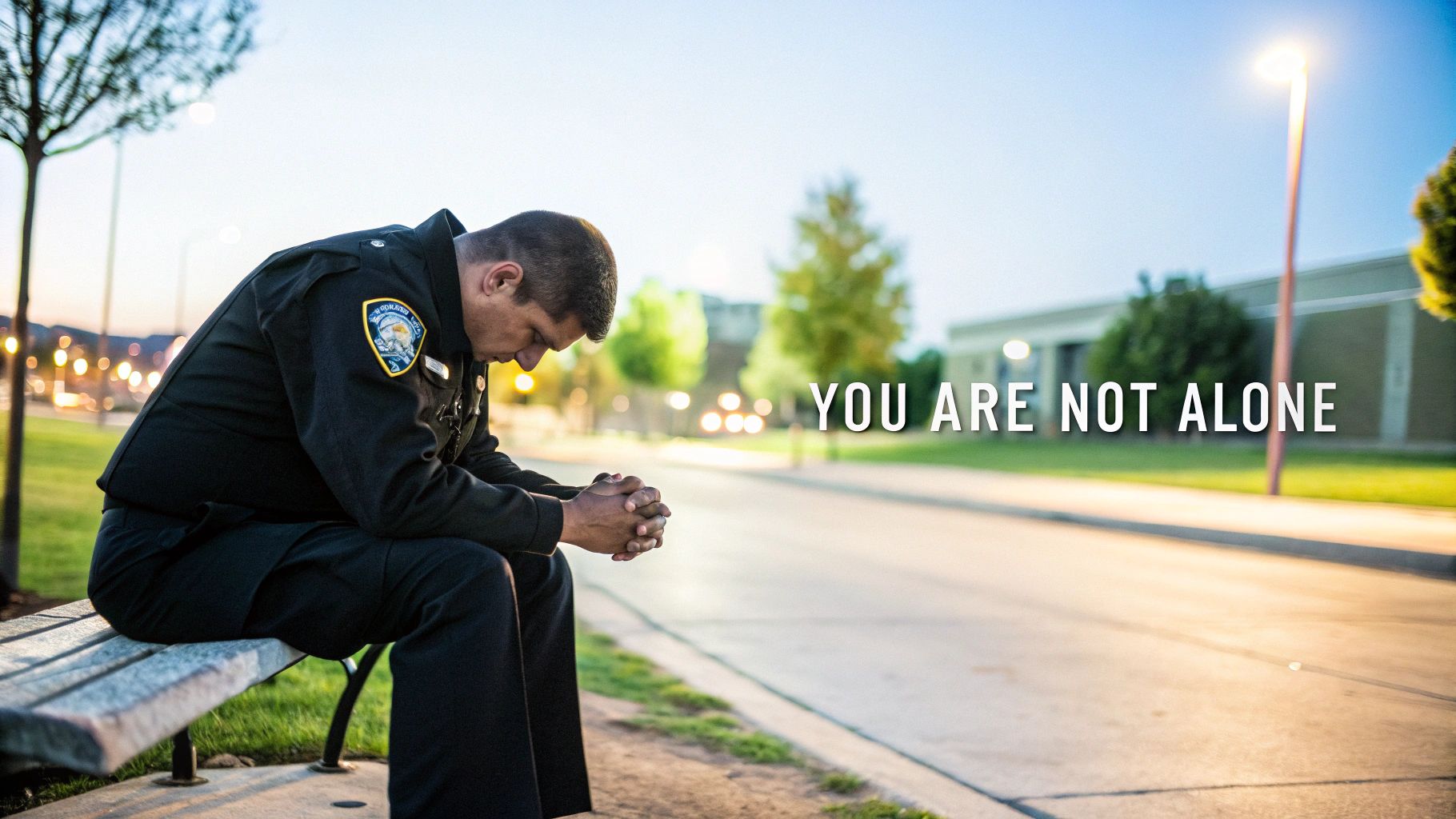
If you’re reading this, please know you are not alone. Your experiences and feelings are completely valid. The weight you carry is real, and simply acknowledging it is the first and most courageous step toward feeling better.
Why This Conversation Matters
The day-to-day reality of police work involves repeated exposure to high-stress calls, genuine trauma, and profound human suffering. Over time, that constant exposure can deeply affect an officer’s well-being, influencing everything from their mood and sleep to their relationships at home. Still, a powerful stigma often prevents officers from reaching out for the help they need and absolutely deserve.
This guide is built on a simple, foundational truth: Prioritizing your mental health is a sign of profound strength and a critical part of a long, healthy career and life.
Our goal is to start breaking down these barriers by providing a non-judgmental, understanding resource. We want to demystify the challenges of mental health in policing and show that support is not only available but effective.
What You Will Find Here
This guide is designed to be both practical and compassionate. We’ll connect the dots between what you experience on shift and how you feel when you’re off-duty, helping you make sense of it all.
Throughout this guide, we will focus on:
- Understanding the Core Issues: We’ll explore the key risk factors like trauma exposure, moral injury, and the physiological strain of constant hypervigilance.
- Recognizing the Signs: We offer gentle guidance for identifying the warning signs in yourself or a loved one.
- Finding Actionable Solutions: We’ll discuss immediate support options, from peer support to specialized therapies that genuinely work for first responders.
- Building a Supportive Culture: We’ll also look at how departments can foster an environment where wellness is treated as a shared priority.
This is more than just information; it’s an invitation to begin a journey of healing. Your well-being matters more than you know, and real support is within reach.
Why Policing Takes a Heavy Toll on Mental Health
It’s one thing to say policing is a stressful job. It’s another to truly get why it takes such a profound toll on your mental and emotional well-being. The impact isn’t from a single bad day; it’s the slow, steady accumulation of experiences that most people will never have to face. If you feel worn down, you’re not alone—it’s a completely understandable response to what the uniform demands.
Think of your emotional capacity as a bucket. Every difficult call, every traumatic scene, every high-stakes decision adds a drop of water.
A domestic dispute adds a drop. A fatal car accident adds another. Over weeks, months, and years, those drops build up, slowly filling the bucket until it’s dangerously close to overflowing. This is cumulative stress.

The Body Keeps the Score
Beyond the slow drip of daily stress, there are the critical incidents—the calls that dump a gallon into your bucket all at once. An officer-involved shooting, a line-of-duty death, or a particularly horrific crime scene can cause acute trauma, overwhelming your nervous system’s ability to cope.
This rewires you for a state of constant readiness known as hypervigilance. On shift, it’s a survival tool that keeps you safe. But the brain doesn’t always know how to switch it off.
Even when you’re home, your nervous system might still be “on duty,” scanning for threats and reacting to every loud noise. This constant state of high alert is physically and mentally exhausting. Learning about the hidden connection between stress and illness can shed light on how this long-term activation can affect your physical health, too.
More Than Just the Calls
The challenges of policing run much deeper than the calls themselves. Several other factors create a complex web of stressors that are just as damaging.
- Disrupted Rhythms: Shift work constantly throws your body’s natural sleep-wake cycle into chaos, impacting everything from your mood to your physical health. It also creates a profound disconnect from family and social life, making you feel isolated even in a crowded room.
- Moral Injury: Sometimes, you’re forced to make decisions or witness events that go against your own moral code. This isn’t PTSD; it’s a deep, soul-level wound that can leave you grappling with guilt, shame, or a sense of betrayal.
- A Culture of Silence: Perhaps the biggest barrier is the powerful, unwritten rule that you must always be strong and in control. This stigma makes it incredibly difficult to admit you’re struggling, let alone ask for help.
The greatest weight isn’t always the trauma you carry, but the silence you carry it in. Feeling like you can’t talk about it is a burden that makes every other challenge heavier.
This pressure to stay silent is tragically common. The mental health crisis among law enforcement officers is a critical public health concern, and the numbers speak for themselves. In California, for example, research from The Peace Officers Research Association of California reveals that 83% of officers report experiencing mental health challenges.
A staggering 35% show symptoms of PTSD—a rate five times higher than the general population. Alarmingly, over 90% of these officers feel discouraged from seeking support because of workplace stigma.
Recognizing the Signs in Yourself and Others
When that trauma bucket we talked about earlier starts to overflow, it’s rarely a sudden flood. It’s more like a slow, quiet leak—showing up in small, often misunderstood ways that are easy to brush off.
Learning to spot these signs, whether in yourself or in someone you care about, is a powerful act of support. These are not signs of weakness or personal failure. They are simply your body’s and mind’s way of saying that your coping system is overloaded and needs a hand.
If you’re an officer, you might notice a constant, low-grade irritability you just can’t shake. Or maybe things that used to bring you joy now feel flat and distant. This emotional numbing is a coping mechanism. It’s your brain’s way of shielding you from more pain, but it can also leave you feeling disconnected from the very people you love most.
For families, these changes can be confusing. An officer who comes home quiet and withdrawn isn’t necessarily angry or uninterested. It’s far more likely they are trying to come down from a state of hypervigilance, their nervous system still buzzing long after the shift has ended. That distance you feel is often their way of searching for a moment of internal peace.

The immense weight of police work can show up in your mind, your body, and your behaviour. If you notice these shifts in yourself or a loved one, try to approach them with gentle curiosity, not judgment. They are just clues that it’s time to pay attention.
The table below outlines some common changes that can signal you or a loved one is carrying too heavy a load. Think of it not as a checklist for diagnosis, but as a gentle guide to help you notice what might be happening beneath the surface.
Common Signs of Stress and Trauma Overload in Police Officers
| Category | What It Might Look Like |
|---|---|
| Emotional Changes | A shorter fuse or sudden anger over small things. Persistent anxiety, worry, or a sense of dread. Feeling emotionally “flat,” cynical, or detached from others. |
| Behavioural Shifts | Withdrawing from friends, family, or hobbies. Relying more on alcohol or other substances to unwind. Changes in sleep—either insomnia or sleeping excessively. |
| Physical Symptoms | Unexplained headaches, stomach problems, or digestive issues. Chronic exhaustion that sleep doesn’t seem to fix. Persistent muscle tension, especially in the neck, shoulders, and jaw. |
These are just a few examples, and the experience is different for everyone. If you’re interested in digging a little deeper, you can learn more about 3 often overlooked symptoms of trauma that might offer more clarity.
Why Everyday Behaviours Can Be Trauma Responses
Sometimes, the most confusing behaviours are actually your nervous system’s smart, automatic survival strategies playing out in real-time. These are coping mechanisms it relies on to handle overwhelming threats. While they are absolutely essential on the job, they can cause a lot of friction at home.
For instance, an intense need to control every small detail of a family outing might be a trauma response. After a day of navigating unpredictable, high-stakes calls, the brain craves order and predictability wherever it can find it. This isn’t about being difficult; it’s a deep need to feel safe.
A sharp temper at home is rarely about the person standing in front of you. More often, it’s a delayed reaction to the stress, danger, or frustration you had to swallow during your shift. It’s a sign of a nervous system that hasn’t had the chance to come back down.
Another common but misunderstood coping mechanism is the fawn response. At its core, this is a subconscious attempt to avoid conflict by being as agreeable and helpful as possible. For an officer, this might look like volunteering for every overtime shift or always saying “yes” to extra duties. It isn’t about being a people-pleaser; it’s a learned survival instinct where keeping others happy feels like the safest way to de-escalate tension and avoid confrontation.
These behaviours—irritability, control, withdrawal, people-pleasing—are not character flaws. They are adaptive survival skills that your brain is using to protect you. Seeing them for what they are is the first step toward finding your balance again.
Actionable Pathways to Healing and Support
Acknowledging you need support is a monumental act of courage. If you’ve recognized some of the signs we’ve discussed in yourself or a loved one, please hear this loud and clear: healing is not only possible, it’s something you absolutely deserve.
There isn’t one single “right” way to start feeling better. There are many different paths, and the goal is to find the one that feels right for you. Taking that first step can feel like the hardest part, but you don’t have to walk this road alone. Support is available right now, designed by people who understand the unique pressures of policing.
Immediate Support For Critical Moments
Sometimes, you need support that can meet you where you are, especially in the immediate aftermath of a difficult call. These resources are built for just that—providing a safe landing space when you need it most.
- Peer Support Teams: Talking to someone who “gets it” without needing to explain the context is incredibly powerful. Peer support teams are made up of fellow officers trained to offer confidential, non-judgmental support. They provide a vital bridge, reminding you that you aren’t the first or only one to feel this way.
- Critical Incident Stress Management (CISM): After a major event like a line-of-duty death or a multi-casualty incident, CISM offers a structured group debriefing. It’s not therapy, but a guided conversation designed to help you and your colleagues process the immediate shock and stress of the event in a safe, controlled environment.
These options are powerful first steps, offering immediate relief and connection. They can be exactly what you need in the moment, and they can also be a gateway to deeper, more personalized healing when you’re ready.
Finding The Right Fit With Professional Therapy
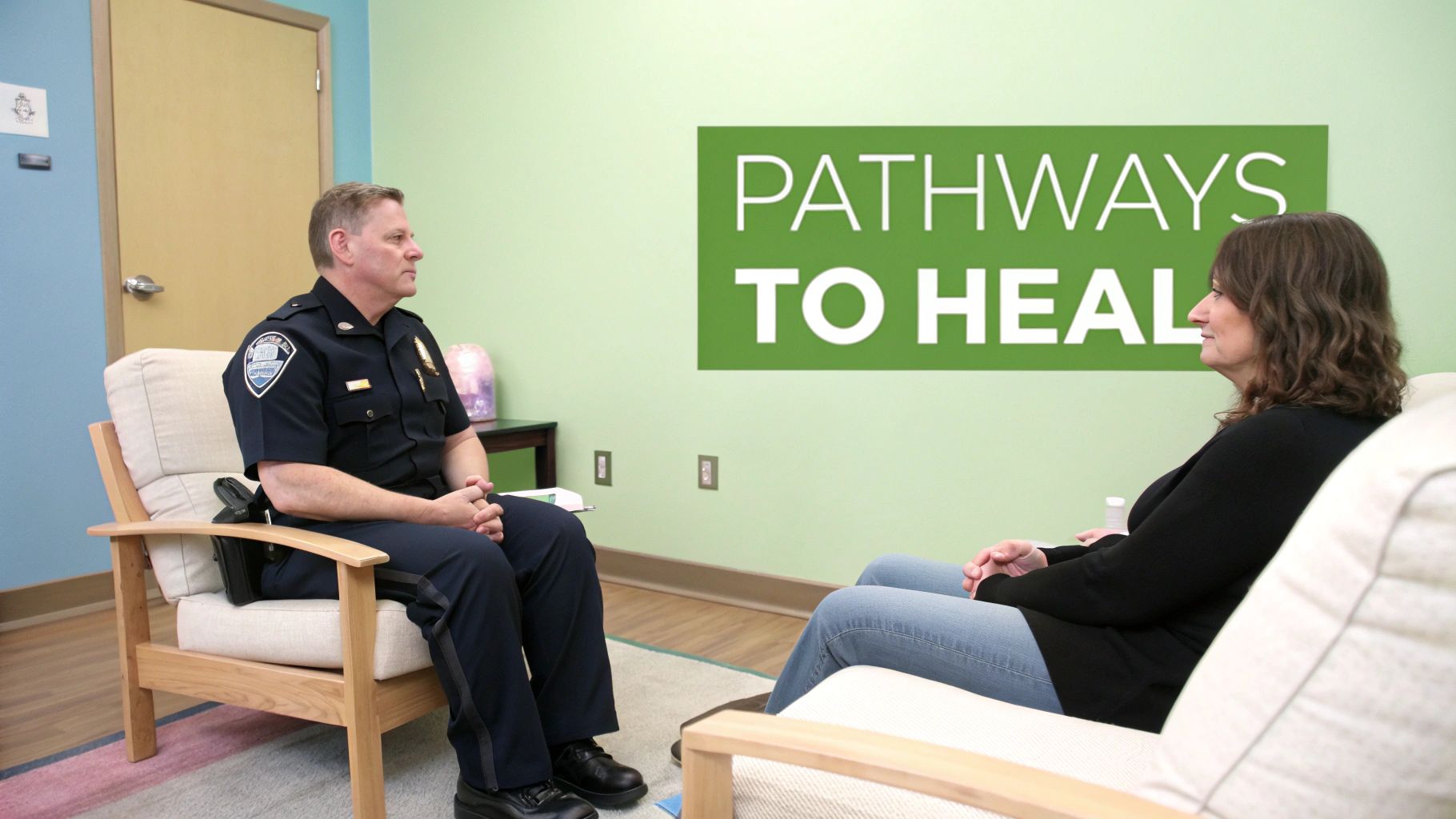
The thought of therapy can be intimidating. At its heart, though, it’s simply a confidential space dedicated entirely to your well-being. It’s a place where you can finally set down the heavy weight you’ve been carrying, without fear of judgment or professional consequence.
The key is finding a therapist who understands the culture of policing and an approach that resonates with you. Two highly effective methods are often recommended for first responders.
Let’s break them down in simple terms.
Processing Memories With EMDR Therapy
Imagine your brain is like a filing cabinet. Most memories get neatly processed and filed away. But traumatic memories are different. They’re like crumpled, oversized files jammed in the drawer, preventing it from closing properly. Every time you brush past the cabinet, the drawer gets stuck, and the memory comes rushing back out with all its original intensity.
Eye Movement Desensitization and Reprocessing (EMDR) is a structured therapy that helps your brain properly file away those jammed memories. Using bilateral stimulation (like side-to-side eye movements or tapping), EMDR helps your brain’s natural processing system finally do its job.
You don’t have to talk in detail about the event over and over again. The goal of EMDR is not to relive the trauma, but to reduce its emotional charge so that the memory loses its power over you. It becomes just a file in the cabinet—something that happened, but no longer controls your present.
Releasing Stress From The Body With Somatic Therapy
Have you ever felt your shoulders tense up before you even realized you were stressed? Or felt a pit in your stomach during a tense situation? That’s your body holding onto stress and trauma, just as much as your mind does.
Hypervigilance, for example, isn’t just a thought pattern; it’s a physical state. Your muscles are braced, and your nervous system is stuck on high alert.
Somatic therapy focuses on helping your body release this stored tension. It’s based on the idea that to fully heal, we need to address the physical sensations of trauma, not just the thoughts and emotions attached to it.
A somatic therapist might guide you through gentle exercises to help you notice where you feel stress in your body and then teach you techniques to release it. It’s about restoring your nervous system’s natural balance, teaching your body that it’s safe to relax again. This approach helps you reconnect with your body and feel more grounded and in control.
Ultimately, the best pathway to healing is the one you’re willing to take. Whether it starts with a confidential call to a peer, exploring EMDR, or learning to release physical tension, taking that first step is a profound investment in yourself, your career, and your family. Your well-being is worth it.
Building a Department Culture of Wellness
An officer’s journey toward healing is deeply personal, but it should never be a journey they have to walk alone.
While individual courage is essential, the responsibility for fostering well-being can’t rest solely on the shoulders of the officer. A truly supportive department culture is the bedrock of sustainable mental health in policing. It’s about transforming the environment from one of silent endurance to one of active, shared responsibility.
This kind of shift has to start from the top down. When leadership openly talks about mental health, champions wellness initiatives, and treats seeking help as a sign of professional strength, it sends a powerful message that ripples through the entire organization. It’s about creating a system where an officer’s well-being is seen as a core component of their effectiveness and longevity in the career.
This means moving beyond just reacting to crises and embracing proactive strategies that build resilience from day one.
Proactive Support Starts at the Academy
Mental wellness and resilience training shouldn’t be a one-time seminar offered after a tragedy. To be truly effective, it must be woven into the fabric of an officer’s career, right from the very beginning at the academy.
Just as recruits learn defensive tactics and firearm safety, they must be equipped with the tools to manage the psychological demands of the job.
This foundational training can include:
- Stress Inoculation: Teaching recruits how their nervous systems will react to high-stakes situations and giving them practical, in-the-moment techniques for emotional regulation.
- Normalizing Help-Seeking: Openly discussing the realities of trauma exposure and presenting therapy, peer support, and other resources as standard, essential tools for a healthy career.
- Family Preparedness: Offering sessions for spouses and partners to help them understand the real-world impact of hypervigilance, shift work, and job-related stress on family life.
Cultivating a culture that prioritizes overall Employee Well Being is crucial for supporting mental health in demanding professions. It’s about building a foundation of awareness and skills that officers can rely on for years to come.
A department that invests in mental wellness from the start isn’t just preventing burnout; it’s investing in the long-term health of its most valuable asset—its people.
Equipping Officers With Better Tools
A key part of building a culture of wellness is giving officers better tools to handle the complex calls they face daily, especially those involving individuals in a mental health crisis. These encounters are incredibly high-stress and can contribute significantly to an officer’s cumulative trauma load.
Programs like Crisis Intervention Team (CIT) training do more than just improve community outcomes; they directly benefit officer well-being. By teaching de-escalation skills and providing a deeper understanding of mental illness, CIT and similar collaborative approaches empower officers to manage volatile situations with greater confidence and less force.
This community-led collaboration is exemplified in London, Ontario’s Crisis Outreach and Support Team (COAST) — a partnership between local health providers and the London Police Service that pairs healthcare professionals with police officers to respond to mental health and addiction crises. The COAST model is designed to reduce the need for police-led responses, divert individuals from unnecessary interaction with the criminal justice system or emergency departments, and connect them with appropriate supports in the community.
Evaluation data from the 2022 COAST Final Report indicates that COAST appears to decrease reliance on police as first responders for mental health-related crises and supports better coordination of care, while also relieving pressures on frontline officers who spend a significant portion of their time on such calls. These findings support the idea that co-response models can improve outcomes for both the community and police responders.
In fact, officers and stakeholders in London report that having mental health professionals integrated into crisis response improves confidence, clarifies roles during complex calls, and contributes to safer de-escalation — reinforcing that greater cooperation with mental health services is a crucial improvement needed for police to do their jobs more safely and effectively.
How Gentle Pathways Provides Specialized Support
Figuring out where to turn for help can feel like the hardest part, especially when you need to know your story will be kept confidential and truly understood. At Gentle Pathways, we’ve built a safe space specifically for first responders and their families right here in the London, Ontario community.
Our team doesn’t just work with high-stress professions—we have direct experience with them. We get the unique pressures that come with a career in policing, from the culture on the inside to the weight you carry home.
You won’t have to waste a single minute explaining what hypervigilance feels like after a tough shift, or why a particular call just won’t leave you alone. We already know. We see you, and we’ve built our entire approach around what you actually need.
Therapy That Understands Your World
We focus on trauma-informed therapies for a simple reason: they work. We’ve seen firsthand how powerful certain approaches can be, especially for the kind of trauma that gets stored in both the mind and the body.
- EMDR Therapy: This isn’t about endlessly talking about the worst moments. Instead, EMDR helps your brain reprocess and properly “file away” those distressing memories. The goal is to get to a place where they no longer trigger a powerful emotional and physical reaction in your day-to-day life.
- Somatic Therapy: The body keeps the score. Somatic work helps you release the deep physical tension and stress that gets held in your muscles and nervous system, finally allowing your body to come down from that constant state of high alert.
Your well-being is everything to us. We are deeply committed to providing a completely confidential, compassionate space where you can build resilience, reconnect with yourself, and find your footing again.
Taking that first step is a true sign of strength, and our goal is to make it as straightforward as possible. We offer both in-person sessions and secure virtual appointments to fit your life and your schedule.
You can learn a bit more about our specific approach in our guide to first responders therapy.
When you feel ready, booking a consultation is a simple, private process. We’re here to help you and your family navigate the path forward with care and expertise.
Common Questions About Mental Health Support for Officers
Taking that first step toward getting help is a big deal, and it’s completely normal to have questions. You might be wondering what therapy actually means for you, your family, and your career. We get it. Here are some straightforward answers to the questions we hear most often, hopefully making the path forward feel a little clearer and a lot less daunting.
Will Seeking Therapy Hurt My Career or Security Clearance?
This is, without a doubt, the biggest and most understandable concern we hear. The short answer is no. In most modern departments, proactively taking care of your mental health is seen as a sign of strength and professionalism, not a weakness.
Confidentiality is the bedrock of therapy—what you say in a session is protected by law. More and more agencies are actively encouraging their people to seek support because they know a healthy officer is an effective one. If you have specific worries about your department, we can talk through them privately and help you navigate the process with total confidence.
How Is Therapy for a Cop Different?
Therapy for anyone in law enforcement has to be culturally competent. This just means your therapist already gets the world you live in—the language, the unique stressors, and the culture of the job. You shouldn’t have to waste time explaining what hypervigilance feels like, the emotional weight of certain calls, or how shift work messes with your life.
At Gentle Pathways, our deep experience with first responders means our approach is built for your reality. You deserve to walk into a room and feel understood from the very first conversation, without having to translate your life.
My Family Says I’ve Changed. How Can Therapy Help Them?
It’s incredibly common for the stress of the job to follow you home and impact your family. Things like pulling away emotionally or being more irritable are often just unconscious ways of coping with everything you see and carry. It’s a defence mechanism.
Therapy can help in two big ways:
- First, it gives you a confidential place to unpack your own experiences, which helps you become more present and engaged when you’re with your family.
- Second, we can also work with your family. Counselling can help them understand the real impact of the job and learn new ways to communicate, connect, and support each other through it all.
What If I Don’t Want to Talk About a Specific Traumatic Call?
You are always in the driver’s seat in your own therapy sessions. Period. While talking through things is one way to heal, it is far from the only way.
Modern, evidence-based approaches like EMDR and somatic therapy are designed to process trauma at the nervous system level, often without you needing to verbally recount every single detail of an event. The goal isn’t to force you to relive it; it’s to take the emotional charge out of the memory so it no longer controls you. We will always move at a pace that feels safe for you.
At Gentle Pathways, we’re here to offer a safe place where you can finally set down the weight of the badge, even if just for an hour. If you’re ready to take the next step for yourself or your family, we’re ready to walk with you. Your courage in seeking support is a testament to your strength.
Learn more about our specialized support for first responders and book a confidential consultation at https://gentlepathways.ca.