EMDR therapy for first responders is a specialized, evidence-based way to process traumatic memories without having to talk through them in exhaustive detail. Using simple techniques like guided eye movements, it helps your brain’s natural healing system finally file away difficult experiences, reducing their emotional weight and helping you build lasting resilience.
Why Your Strength Deserves a Space to Heal
As a first responder, you’re the person running toward the chaos while everyone else is running away. You carry the weight of things most people can’t even imagine, and you do it with a level of strength that is both incredible and incredibly demanding. But that strength doesn’t make you immune to the toll this work takes.
If you find yourself constantly on edge, feeling a million miles away from your family, or replaying a tough call long after the sirens have faded, please know you are not alone. And what you’re feeling is valid. These aren’t signs that you’re failing or weak. They are the honest, human responses of a nervous system that has been pushed to its limit, again and again. It’s your body’s intelligent way of trying to keep you safe in a world that often feels unpredictable.
Understanding Your Body’s Protective Signals
The culture in your line of work often values stoicism, but the human brain has its own playbook for survival. What might feel like irritability, shutting down, or being “difficult” are actually powerful, protective mechanisms designed to get you through the unthinkable. They are coping strategies, not personal failures.
- Hypervigilance: That constant need to scan a room or the inability to truly relax isn’t paranoia. It’s your brain stuck in “on-duty” mode, a learned skill that keeps you safe on the job but can be exhausting at home. It’s trying to anticipate the next threat to protect you and those around you.
- Emotional Numbing: Feeling detached or finding it hard to connect with joy doesn’t mean you’ve stopped caring. It’s a coping mechanism your mind uses to create distance from overwhelming emotions so you can keep functioning. It’s a form of self-preservation.
- Intrusive Memories: Flashbacks and nightmares aren’t you choosing to dwell on the past. They are unprocessed memories that have gotten “stuck” and are replaying because your brain hasn’t been able to file them away as “over.”
These responses are a testament to everything you’ve navigated. First responders frequently endure trauma that can result not just in PTSD but also comorbid posttraumatic stress disorder, where it exists alongside other mental health challenges, calling for a truly comprehensive approach to healing.
A Path Forward That Honours Your Experience
This guide is an introduction to Eye Movement Desensitization and Reprocessing (EMDR) therapy—a method that understands the unique nature of occupational trauma. It’s not about erasing what you’ve seen; it’s about working with your brain’s own healing capacity to finally process and store those memories properly, so they no longer run your life.
The goal isn’t to forget what you’ve been through. It’s to remove the painful emotional and physical charge that’s stuck to the memories, lightening the load you carry every single day.
EMDR therapy helps reframe these survival responses into pathways for healing.
From Survival Mode to Healing Mode
| What You Might Be Experiencing (Your Body’s Survival Signals) | How EMDR Therapy Helps (Your Path to Reclaiming Calm) |
|---|---|
| Feeling “stuck” on a bad call, with images or sounds replaying in your mind. | Helps your brain “unstick” and process these memories so they no longer intrude on your present. |
| Constant on-edge feeling (hypervigilance) that makes it impossible to relax, even at home. | Teaches your nervous system that the threat is over, allowing you to feel safe and present with your loved ones. |
| Emotional numbness or feeling disconnected from the people and activities you once loved. | Gently helps you reconnect with your emotions in a safe, manageable way, without feeling overwhelmed. |
| Avoiding places or situations that remind you of traumatic events. | Reduces the emotional trigger associated with these memories, giving you the freedom to reclaim parts of your life. |
| Physical tension, unexplained aches, or difficulty sleeping. | Releases the trauma stored in your body, leading to physical relief and more restful sleep. |
This therapy offers a structured way to help your mind and body finally understand that the danger has passed, and you don’t have to talk endlessly about the details if you don’t want to. To learn more about the specific challenges faced by law enforcement, you can read our insights on mental health in policing.
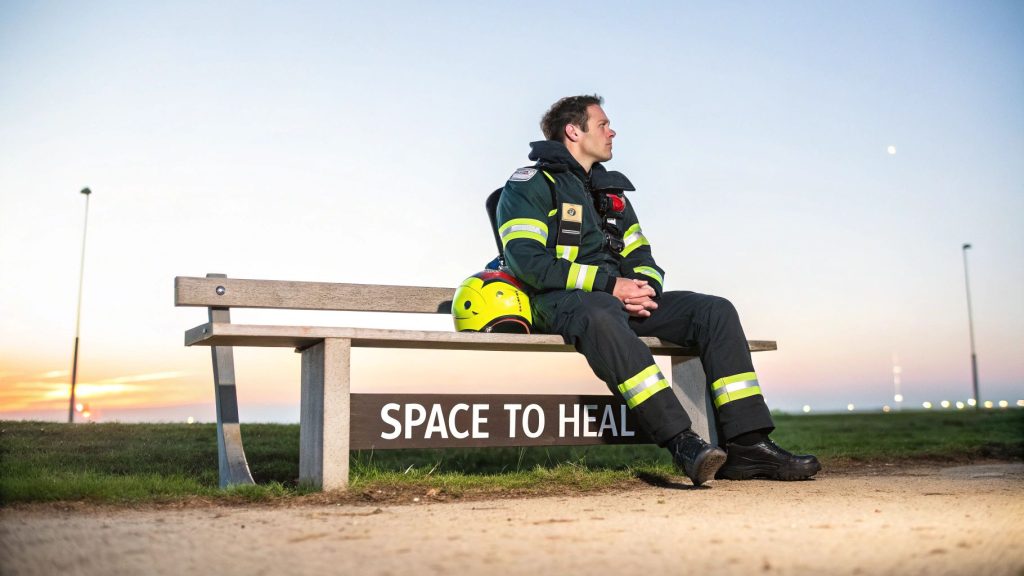
This is your space to heal. Taking that first step is an act of profound strength.
How EMDR Helps Your Brain Process Trauma
Think of your brain like a library, where every single experience is a book. Most days, your brain’s librarian does a fantastic job, neatly filing away each book—what you had for lunch, a chat with your partner, the route you drove to work—onto the shelves in the “Past Events” section. It’s an efficient, orderly system.
But a traumatic event isn’t a normal book. It’s more like a huge, chaotic scrapbook, overflowing with intense emotions, physical sensations, and scattered images. It’s too messy for the librarian to file, so it gets left right in the middle of the library floor. Now, every time something reminds you of that event—a specific sound, a smell, a familiar place—you trip over that scrapbook, and its contents spill out, pulling you right back into the moment.

This is exactly what happens with unprocessed trauma. The memory isn’t stored correctly; it’s stuck. EMDR (Eye Movement Desensitization and Reprocessing) therapy acts like a master librarian, giving your brain the support it needs to finally sort through that messy scrapbook and put it away.
Activating Your Brain’s Natural Healing System
EMDR uses something called bilateral stimulation—often guided eye movements, but sometimes tapping or sounds—to get both sides of your brain working together. This simple, rhythmic process helps to “unlock” the stuck memory and switch on your brain’s own incredible information processing system. It’s a lot like what happens during REM sleep, when your brain naturally sorts through the day’s events.
The good news is you don’t have to talk endlessly about what happened. Instead, you briefly call the memory to mind while the bilateral stimulation helps your brain do the heavy lifting in the background. The goal isn’t to forget the event, but to strip away its emotional power.
EMDR helps separate the memory from the pain. The event becomes just that—a memory—instead of something that feels like it’s happening over and over again.
Imagine that scrapbook is still in the library, but now it’s neatly bound and put on the right shelf in the “Past Events” section. You know it’s there, and you can look at it if you want to, but you’re no longer tripping over it when you least expect it.
Why This Is Different for First Responders
For first responders, this isn’t about just one scrapbook on the library floor. It’s often dozens of them, piling up call after call. This accumulation of stress is precisely why symptoms like hypervigilance or emotional numbness are so common. They aren’t signs of weakness; they are your brain’s intelligent attempt to navigate a library that has turned into an obstacle course.
The impact of occupational stress on Canadian first responders is significant and well-documented. National research suggests that approximately 44–45% of Canadian public safety personnel (including firefighters, paramedics, police, correctional officers, and dispatchers) screen positive for at least one mental disorder, with PTSD rates estimated around 23% for paramedics, 17–20% for firefighters, and 14–16% for police officers — substantially higher than the general Canadian population.
Reframing Your Inner Narrative
One of the most powerful things EMDR does for first responders is help change the negative beliefs that get welded to traumatic memories.
A memory of a tough call might be tangled up with a belief like, “I should have done more.” That thought can create a crushing weight of guilt and shame that replays long after the sirens have faded. During EMDR, your brain can naturally start connecting that memory to more accurate, adaptive information, like:
- “I did the best I could with what I knew at the time.”
- “That situation was beyond my control.”
- “I am strong for having gotten through that.”
This isn’t something you have to force. The shift happens on its own, organically. The therapy simply clears the pathway so your own mind can find a healthier, more compassionate perspective. It’s about restoring your sense of capability and finally letting your brain close the file on what’s past.
What to Expect During Your EMDR Sessions
Walking into a therapist’s office for the first time can feel like stepping into the unknown—especially when you’re used to being the one taking control of uncertain situations. We get that.
That’s why we want to pull back the curtain on EMDR. It’s not some mysterious process, but a structured, respectful, and collaborative journey where you are always in the driver’s seat.
EMDR follows a clear, eight-phase path, almost like a protocol you’d use on a call. This structure is designed to build safety and trust right from the start, ensuring you never feel rushed or pushed into something you’re not ready for. Your therapist is your guide, but it’s your own brain and nervous system that set the pace.

Phase 1 and 2: Laying a Safe Foundation
The first couple of phases are all about preparation. We don’t dive into the deep end right away. Instead, your therapist will take the time to get to know you, understand the unique pressures of your job, and learn about what brought you here.
More importantly, these early sessions are dedicated to equipping you with practical tools to manage distress. Think of it like checking your gear before heading out. We’ll work together to build your toolkit of grounding techniques—simple, effective strategies you can use anytime to stay anchored in the present. These skills are essential because they ensure you can navigate difficult feelings safely, both in our sessions and outside of them.
You will never be asked to process a traumatic memory until you feel ready and have the resources to stay grounded. Safety is always the first priority.
Phase 3 Through 6: The Heart of the Work
Once you feel prepared and have a strong therapeutic relationship, we move into the processing phases. This is where the bilateral stimulation—like guided eye movements or gentle tapping—comes in. You’ll be asked to bring a specific memory to mind, along with the negative thought and tough feelings attached to it.
Then, your therapist will start the bilateral stimulation. Your only job is to let your brain make whatever connections it needs to. You don’t have to talk about the memory in detail unless you want to. Your brain instinctively knows how to heal; the stimulation just helps it get unstuck.
For example, a first responder might start with a memory of a pediatric call that’s been haunting them for years, linked to the belief, “I failed.” As the sets of bilateral stimulation continue, their brain might spontaneously connect this to other memories: times they did make a difference, praise from a supervisor, or the face of a child they saved. Slowly, the original memory’s power begins to fade.
The negative belief, “I failed,” can naturally shift to something more accurate and compassionate, like, “That was a tragic situation, and I did everything I could.” This is your brain reorganizing the memory—filing it away not as a current threat or personal failure, but as a difficult event from the past that you survived.
Phase 7 and 8: Looking Toward the Future
The final phases are about integration and solidifying your progress. In Phase 7, you and your therapist make sure the memory has been fully processed and no longer causes distress. This often involves keeping a brief log between sessions to notice any new insights or feelings that come up.
Phase 8 is about looking forward. Using the same bilateral stimulation, you can “install” a positive belief or visualize handling future challenges with your newfound resilience. It’s like a mental rehearsal that prepares you to meet future stressors from a place of strength and calm, rather than from a place of past trauma.
The entire process is methodical and gentle. EMDR therapy for first responders isn’t about erasing your experiences—it’s about giving your own mind the space to heal, so the weight of the past no longer dictates your present.
If you’re curious about the science behind all this, feel free to learn more about how EMDR works in our detailed guide.
Healing Beyond Just Talk Therapy
After a tough shift, have you ever felt that tightness in your chest that just won’t go away? Or a jaw you can’t seem to unclench? What about that constant, humming tension that makes it impossible to truly rest?
That’s not just in your head. Trauma isn’t only an emotional wound; it’s a physical one. As the saying goes, your body keeps the score.
For first responders, the body often becomes a storage unit for the stress of countless emergencies. This is precisely why just talking about what happened sometimes isn’t enough to bring real, lasting relief. To truly heal, we need to go deeper and address the physical imprint these experiences have left behind.
This is where integrating somatic (body-based) therapies with EMDR becomes so powerful. We focus on helping your body release the built-up tension and finally complete the protective responses that got “stuck” during overwhelming calls.

Understanding Your Body’s Survival Instincts
Many of the behaviours and feelings you might be struggling with are often misunderstood, even by you. But they aren’t character flaws or signs of weakness. They are intelligent, adaptive survival strategies your body adopted to get you through the unthinkable.
Let’s reframe some of these common responses:
- Hypervigilance: That constant scanning of your surroundings isn’t you being paranoid. It’s your body’s brilliant attempt to stay one step ahead of danger—a skill that serves you well on the job but can be exhausting at home. Your nervous system is simply stuck in “threat detection” mode.
- The “Fawn” Response: This is a survival tactic you might not even realize you’re using. In simple terms, it’s a deep-seated instinct to keep the peace. It often looks like excessive people-pleasing, going along with things to avoid conflict, or apologizing for things that aren’t your fault. It’s your nervous system’s way of trying to de-escalate potential threats by being as helpful and agreeable as possible.
- Physical Shutdown (Freeze): Ever feel numb, disconnected, or like you’re watching your life from a distance? This isn’t you being cold or uncaring. It’s your body’s most ancient survival tool—playing dead to endure an overwhelming situation. It’s a way to conserve energy and emotionally check out when a threat feels too big to fight or flee.
These are not personal failures. They are your body’s automatic, protective responses to an overwhelming amount of stress.
Your symptoms are not the problem; they are your body’s attempt at a solution. Our work together is to gently show your nervous system that the threat has passed, and it no longer needs to work so hard to protect you.
Reconnecting Mind and Body for Deeper Healing
Combining EMDR therapy for first responders with a somatic approach creates a path to whole-person healing. While EMDR helps your brain reprocess the memories, somatic techniques help your body release the stored energy of those events.
This might look like noticing where you feel tension in your body as you talk, or using gentle, guided movements to help “un-stick” a frozen fight-or-flight response. The goal is to help your body finally complete the defensive actions it couldn’t take during the actual event.
This process helps you learn your body’s language again. You begin to differentiate between real, present-moment threats and the echoes of past trauma. Slowly, you can teach your nervous system that it is safe to stand down, to relax, and to be truly present with your loved ones.
Healing isn’t about becoming someone new; it’s about returning to yourself. It’s about finding that sense of safety and ease inside your own skin again. You’ve taken care of others for so long—this is your opportunity to give that same level of care to yourself.
Finding an EMDR Therapist Who Understands Your World
Taking that first step to find a therapist is a huge act of strength. For a first responder, the connection you have with that person can make or break the entire process. It’s not just about finding someone with the right letters after their name; it’s about finding someone who gets it.
You need a guide who understands the culture, the gallows humour, and the crushing weight that comes with wearing the uniform.
That relationship—the feeling of being seen and understood without judgment—is the absolute foundation of healing. Without that trust, it’s almost impossible to feel safe enough to do the deep, hard work of processing trauma. A good therapist will meet you exactly where you are, honouring your experience and never pushing you to go faster than you’re ready.
What to Look for in a Clinician
Finding the right person is a mix of looking for specialized training and that gut feeling of a real connection. Your therapist needs to be skilled in EMDR therapy for first responders and also be culturally competent—someone who understands the unique pressures you face every single day.
Here are a few key things to keep an eye out for:
- Experience with First Responders: Have they actually worked with police, firefighters, or paramedics? They should be familiar with the realities of the job, like cumulative trauma and occupational stress, not just the textbook definitions.
- A Trauma-Informed Approach: This is non-negotiable. It means they see your symptoms as survival strategies, not personal failures. They know their first job is to create a space that feels safe and empowering for you.
- EMDRIA Certification: Look for a therapist certified by the EMDR International Association (EMDRIA). This is a good indicator that they’ve met rigorous standards for both their training and hands-on experience.
The goal is to find a professional who feels like an ally—someone you can trust to navigate the tough memories with you, not just an outsider looking in.
Questions to Ask During a Consultation
Most therapists offer a free, brief consultation call or meeting. This is your chance to interview them and see if it feels right. Don’t ever hesitate to ask direct questions that matter to you.
Consider asking things like:
- What’s your experience working with folks in my line of work?
- How do you help create a safe environment for processing really difficult memories?
- What’s your game plan if I start to feel overwhelmed during a session?
Listen to your gut here. Your intuition is a powerful tool. Healing is a team effort, and finding the right partner to walk that path with you is the most important first step you can take. To see how we support this journey, learn more about our specialized first responders therapy services.
Common Questions About EMDR for First Responders
Stepping into therapy can bring up a lot of questions, especially when it’s something as different as EMDR. You’re used to having a clear protocol and knowing exactly what you’re walking into. It’s completely normal to want that same clarity here.
Let’s walk through some of the most common questions and concerns we hear from first responders. My goal is to give you direct, honest answers so you can feel more comfortable and informed about this path. Your questions are valid, and you deserve to feel confident in your choices.
Will I Have to Talk About Everything in Detail?
This is one of the biggest concerns for many first responders, and the answer is a clear no. One of the most significant benefits of EMDR therapy for first responders is that it does not require you to endlessly talk about the traumatic events you’ve experienced.
Unlike traditional talk therapy, you won’t be asked to rehash every detail of a difficult call. Instead, you’ll briefly bring the memory to mind while your brain does the healing work in the background, guided by the bilateral stimulation. This makes it a powerful option if the thought of reliving your experiences verbally feels overwhelming—or just isn’t your style.
How Long Does EMDR Therapy Take to Work?
There’s no one-size-fits-all timeline, but many people begin to feel a shift much faster than with other forms of therapy. Some studies have shown that even a few sessions can lead to significant reductions in PTSD symptoms.
The speed of the process often depends on the nature of the trauma. A single-incident trauma might be processed relatively quickly, while the cumulative stress built up over a long career may take more time. The most important thing is that we move at a pace that feels safe and manageable for you. You are always in the driver’s seat.
The goal isn’t to rush through healing, but to create lasting change. Your nervous system sets the pace, and your therapist is there to ensure you feel supported every step of the way.
Is EMDR Safe? What if I Get Overwhelmed?
Safety is the absolute cornerstone of EMDR therapy. Your therapist will spend the first several sessions building a strong foundation of trust and equipping you with practical grounding techniques. Think of these as your own toolkit for staying anchored in the present moment if things start to feel intense.
You will never be asked to process a memory until you and your therapist both agree that you are ready and have the resources to do so safely. If you ever feel overwhelmed during a session, your therapist will immediately guide you back to a state of calm using the very techniques you’ve practiced. You are never left to navigate difficult feelings alone.
Can EMDR Help with Symptoms Beyond Just PTSD?
Absolutely. While EMDR is famous for treating PTSD, its benefits extend far beyond that. The weight of your job can show up in many ways, and EMDR can effectively address a wide range of related challenges:
- Anxiety and Hypervigilance: It can help calm a nervous system that’s stuck in high-alert mode.
- Burnout and Emotional Numbness: It helps you reconnect with your feelings in a safe way, without feeling flooded.
- Sleep Disturbances: As your brain processes unresolved stress, many people find their sleep quality improves dramatically.
- Chronic Pain and Physical Tension: By releasing trauma stored in the body, it can lead to very real physical relief.
For paramedics, who often face some of the highest rates of PTSD—up to 22% in California—the need for effective care is critical. Their frequent exposure to severe injuries and fatalities creates a heavy burden. Systematic reviews have confirmed that psychological interventions like EMDR are highly effective at reducing PTSD symptoms in this group. You can read more about the research on EMDR’s effectiveness for paramedics.
You Don’t Have to Carry This Weight Alone
Deciding to ask for help is one of the bravest moves you can make. It’s not a sign that you’re broken or failing—it’s an act of incredible strength. It’s a commitment to yourself, your family, and the future you deserve.
The weight of what you carry can feel isolating, but you don’t have to walk this path alone. Healing is possible. This isn’t just about getting rid of symptoms; it’s about reclaiming your peace, getting back to the people and things you love, and feeling like yourself again.
We get it. Taking that next step can feel huge. That’s why we always say to start small, with whatever feels manageable right now.
Your Invitation to Heal
Your well-being matters. You’ve dedicated your career to showing up for people on their worst days. Now, it’s time to show up for yourself with that same commitment. This is your invitation to put your own health first and start the healing process.
You deserve to feel calm and safe, both on and off the job. You deserve to be fully present with the people you love without the ghosts of past calls showing up uninvited. Healing gives you the chance to find that again.
Reaching out for help isn’t a sign of weakness. It’s a strategic move to take back your strength and resilience from the memories that have held you captive.
Resources to Support Your Journey
Whether you’re ready to talk to a therapist or just want to gather more information, we’re here to support you in whatever way feels right. Below are a few resources to help you take that next step, whenever you’re ready.
- Learn About Our Approach: Find out more about our specialized Trauma & EMDR Therapy, designed with the unique pressures of first responders in mind.
- Schedule a Free Consultation: We invite you to a no-pressure, confidential chat to see if our approach feels like the right fit. We’re here to answer your questions and help you feel comfortable.
- Find Peer Support: Organizations like Boots on the Ground offer peer and crisis support built specifically for first responders across Canada. These are safe spaces to connect with people who truly understand what you’re going through.
This is your moment. You can choose a different path forward.
At Gentle Pathways, we provide a safe, understanding space for first responders to heal from the weight of their work. If you are ready to take the first step, we invite you to connect with us.