
When you feel yourself starting to drift, it can be scary. Grounding techniques are like a gentle hand on your shoulder, reminding you that you’re right here, right now. These are simple practices designed to pull your awareness back to the present moment, especially when you feel disconnected, foggy, or like you’re floating away.
They work by using your senses, your body, and the world immediately around you to create a sense of stability. Think of it like dropping an anchor in a stormy sea. These methods aren’t about pushing away difficult feelings, but about gently and kindly guiding yourself back to solid ground. Your experience is valid, and learning these tools is an act of profound self-care.
Understanding Dissociation and Why Grounding Helps

If you’ve ever felt like you’re watching your life from behind a thick pane of glass, or as if you’re just a passenger in your own body, you’ve experienced dissociation. It can feel confusing and even frightening, but I want you to know this: it is not a sign of weakness or a personal failure.
Dissociation is actually a powerful coping mechanism your brain uses when it’s completely overwhelmed. It’s like an automatic circuit breaker. When stress, anxiety, or trauma becomes too much to process, your mind creates distance to protect you from the full, crushing intensity of the experience.
It’s a survival strategy, not a flaw. It’s a sign of what you’ve had to endure, not a sign of something being wrong with you.
What Does Dissociation Actually Feel Like?
This protective “checking out” can show up in all sorts of ways, and whatever your experience is, it’s valid. Sometimes it’s subtle, like realizing you can’t remember the last few minutes of a conversation. Other times, it’s much more intense.
To help you recognize it, here are some common ways dissociation can appear in everyday life. Seeing your own experience in this list might feel validating—you are not alone in this.
Common Ways Dissociation Can Show Up
| Feeling or Sensation | What It Might Look Like in Real Life |
|---|---|
| Detachment | Feeling like you’re floating outside your body, watching yourself go through the motions. |
| A Sense of Unreality | The world around you might seem dreamlike, blurry, or like you’re watching it on a TV screen. |
| Numbness | Not feeling physical pain or emotions with the usual intensity; feeling “flat” or muted. |
| Memory Gaps | Not being able to recall significant chunks of time, important events, or personal information. |
| Zoning Out | Staring off into space for long periods without realizing it. |
| Feeling Robotic | Moving or speaking automatically, without any real connection to your actions. |
Recognizing these signs is the first step. It’s your cue that your nervous system is overwhelmed and needs some gentle support to come back to the present.
It’s also helpful to see how this fits into our broader understanding of trauma responses. You’ve likely heard of “fight or flight,” but there are quieter ways our bodies try to keep us safe. The “fawn” response, for instance, is a coping mechanism where we try to please others to avoid conflict or danger. It’s not about being a “people-pleaser” out of weakness; it’s a deeply ingrained survival strategy to maintain connection and safety. Another is the “freeze” response, where we feel stuck, paralyzed, and unable to move or speak.
Dissociation is deeply connected to this “freeze” state—it’s a mental escape when a physical one isn’t possible.
How Grounding Creates an Anchor
This is where grounding techniques for dissociation become so invaluable. If dissociation is your mind drifting away into a stormy sea of overwhelm, grounding is the act of dropping a heavy anchor to hold you steady.
It doesn’t make the storm disappear instantly, but it stops you from being carried away by the current.
Grounding is about reconnecting with the present moment in a gentle, non-judgmental way. It sends a simple, powerful message to your nervous system: “I am here. Right now, in this moment, I am safe.”
By intentionally focusing on the physical world—the solid feeling of your feet on the floor, the scent of coffee in the air, the sound of rain against the window—you give your mind something tangible to hold onto.
This simple act of reconnection can interrupt the dissociative state, dial down the intensity of fear, and bring back a sense of control. It’s a compassionate way to guide yourself back home to your body. For a deeper dive into this, you can learn more about finding safety in your own skin in our detailed article.
Remember, learning to use these techniques is a skill. And like any skill, it takes practice. Be patient and incredibly kind with yourself as you explore what works for you. You are more than capable of navigating these moments.
Using Your Senses to Anchor Yourself in the Present

When your mind starts to drift and the world feels distant, your five senses are often the kindest and quickest way back to yourself. They are your body’s built-in anchors, always available to connect you to the solid reality of the here and now. The idea isn’t to force yourself back with a jolt, but to gently invite your awareness to land on something real.
Think of these as gentle invitations, not commands. The most effective grounding techniques are always the ones that feel safest and most comforting to you. Let yourself be curious, move slowly, and notice what your body responds to.
Finding Solid Ground Through Touch
Touch can be an incredibly direct way to interrupt that feeling of floating outside your own body. It offers immediate, physical proof that you are solid and present. The next time you feel that familiar unreality creeping in, try connecting with a simple physical sensation.
This doesn’t need to be complicated. It could be as simple as reaching into the fridge for a cold orange. Feel its surprising weight in your palm, the cool, bumpy texture of its skin, and the faint citrus scent it leaves on your fingers. This small, concrete experience can be a powerful tether.
Here are a few other ideas for using touch to feel more present:
- Notice your clothing. Rub the soft fabric of your sleeve or the rougher weave of your jeans between your fingers. Focus completely on that single sensation.
- Press your feet into the floor. Feel the solid ground beneath you, holding you up. You can even wiggle your toes inside your shoes just to notice the feeling.
- Hold a piece of ice. The sharp, intense cold is very difficult for the brain to ignore, pulling your focus directly into the physical moment.
- Wrap up in a weighted blanket. For many people, the gentle, steady pressure can feel like a secure hug, bringing a profound sense of safety to the nervous system.
Reconnecting Through Sight with the 5-4-3-2-1 Method
When your surroundings start to look blurry or feel like a scene in a movie, actively engaging your sight can bring the world back into focus. One of the most well-known sensory techniques is the 5-4-3-2-1 method. It’s a simple practice that gently guides your attention outward, using all of your senses to reconnect you to your environment.
The key is to just notice, without any judgment. Simply observe.
Let’s walk through it together. Just for a moment, pause and let your eyes soften.
Name five things you can see. Don’t just list them; truly see them. “I see a blue pen with a chewed-up cap.” “I see the afternoon light catching dust motes in the air.” “I see the rich green leaves on my houseplant.”
Acknowledge four things you can feel. “I can feel the smooth, cool surface of the desk under my palms.” “I feel my back pressing into the chair.” “I feel a slight breeze from the open window on my arm.”
Listen for three things you can hear. “I can hear the quiet hum of my laptop.” “I can hear the distant sound of traffic outside.” “I can hear the sound of my own breathing.”
Notice two things you can smell. Maybe it’s the faint scent of your morning coffee still in the air, or the clean smell of soap on your clothes.
Identify one thing you can taste. This could be as subtle as the lingering taste of toothpaste or the last sip of water you took.
This isn’t about getting it “right.” It’s about gently shifting your focus from the storm inside to the quiet reality of your immediate surroundings.
Using Sound and Scent to Come Back to Now
Sound and scent are deeply wired to our memories and emotions, which makes them incredibly powerful grounding tools. Sometimes, total silence can make the internal noise of dissociation feel even louder. A steady, neutral sound, on the other hand, can give your mind something else to hold onto.
You could try:
- Listening to the hum of a fan or playing a white noise track. That consistent, predictable sound can be incredibly soothing.
- Turning on some music that feels comforting and familiar. Something with a steady rhythm you can tap your foot or fingers to can be especially helpful.
- Smelling something strong and pleasant. Keep a small bottle of lavender or peppermint essential oil nearby. You could also peel a clementine, crush a mint leaf between your fingers, or just smell the spices in your kitchen. Scent can bypass the thinking part of our brain and connect us directly to the present.
These are all different ways of communicating with your nervous system in its own language. For more ideas, this list of 8 practical grounding techniques for anxiety has some great strategies that are also very helpful for dissociation. And if you’re curious about deepening this connection, you might be interested in exploring the healing power of nature and forest bathing. The best approach is to experiment and discover which anchors work best for you.
How Your Mind and Body Can Reconnect You
While turning to your senses is a powerful way to come back to the present moment, sometimes the most immediate tools you have are your own mind and body. When you feel disconnected, they can become your closest allies, gently guiding you back and reminding you that you are right here, right now.
This isn’t about forcing positive thoughts or doing an intense workout. It’s much simpler. It’s about using small, conscious actions—both in your head and with your body—to interrupt the drift of dissociation. These small acts send a clear, calming message to your nervous system: you are here, and you are safe.
Using Your Mind as an Anchor
There are moments when the world outside feels like too much, making it hard to focus on a sensory object. That’s when you can turn inward and use your mind as a gentle but firm anchor. The idea is to give your brain a simple, neutral job to do, which pulls its attention away from that feeling of unreality.
Think of it like giving a lost puppy a straightforward command. You’re just saying, “Hey, let’s focus on this one small thing together.”
Here are a few gentle mental exercises to try:
- Describe your space like a reporter. Look around and silently state the facts, without any judgment. “The walls are a soft grey. There is a wooden desk in front of me. A black lamp is on the desk.” Stick to what you see, leaving out any emotion or story.
- Play a simple category game. Try to mentally list all the animals you can think of that start with the letter ‘B’. Or name all the cities you can remember. This small cognitive task requires just enough focus to help pull your mind back into a more present state.
- Count things by colour. Scan the room and count every single blue object you can find. Once you’re done, pick another colour and start again. The act of searching and counting gives your mind a specific, manageable task.
The goal here isn’t to solve a puzzle or find the “right” answer. It’s simply to engage your thinking brain in a low-stakes activity, gently pulling it out of the fog of dissociation and back into the room.
These cognitive strategies are widely seen as effective ways to manage dissociation. Finding what works for you is the most important part of the journey.
Reconnecting Through Gentle Physical Movement
When you dissociate, you might feel like you’re floating or that your body isn’t really yours. Gentle, intentional movement is a powerful way to counteract this feeling by reminding you of your own physical presence. This isn’t about exercise—it’s about sensation. It’s about reaffirming that your body exists in space and time.
Even the smallest movements can send powerful signals of safety and presence to your brain.
Simple Movements to Reaffirm Your Presence
- Press your heels into the floor. Whether you’re sitting or standing, consciously push your heels down. Notice the solidness of the ground beneath you and the subtle engagement of the muscles in your legs. Feel the floor supporting you.
- Gently push against a wall. Place your palms flat against a nearby wall and lean into them. Focus on the firm surface pushing back against your hands. This creates a clear physical boundary and direct feedback.
- Slowly roll your shoulders. Lift your shoulders up toward your ears, then slowly roll them back and down. Pay close attention to the entire movement—the stretch, the release, the feeling of your shoulder blades shifting.
- Clench and release your fists. Make a tight fist, squeezing for a few seconds while noticing the tension. Then, slowly open your hand and feel the release as your fingers relax. This contrast can be incredibly grounding.
These simple actions are a direct conversation with your nervous system. They anchor you in your physical self, helping to bridge the gap that dissociation creates. For a deeper connection between your mind and body, exploring essential meditation techniques can be a wonderful complement to your grounding practice.
Remember, the relationship between our mental state and physical well-being is incredibly deep. To learn more about this, you can read our guide on unraveling the mind-body link.
Every small step you take to reconnect is a testament to your own strength. Be patient with yourself, and trust that your mind and body know the way back home.
Creating a Personalized Grounding Kit for Any Situation
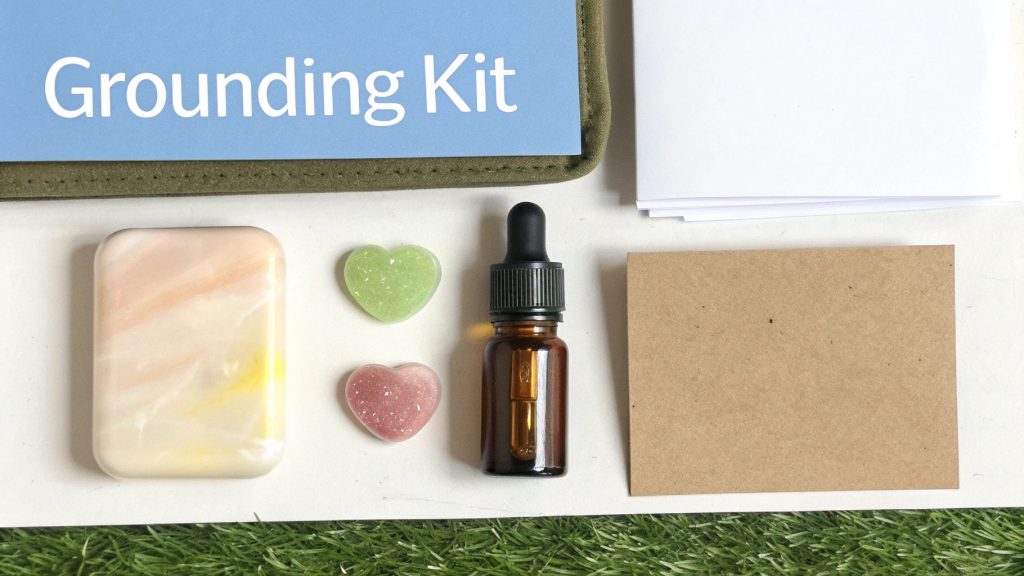
When you feel yourself starting to drift, being prepared can make all the difference. Assembling a personalized grounding kit is a wonderfully compassionate act of self-care. It’s like leaving a kind note for your future self that says, “I know this gets hard, and I’ve got everything you need right here.”
A grounding kit is more than just a collection of objects; it’s a tangible reminder of your own strength and resourcefulness. When you have these tools ready, you spend less energy flailing for an anchor in a moment of distress and more time gently guiding yourself back to the here-and-now.
This isn’t about trying to stop dissociation from ever happening. It’s about building a reliable, comforting toolkit you can reach for when you need it most, empowering you to respond to your body’s signals with confidence and care.
Building Your Physical Grounding Kit
A physical kit is something you can keep in your bag, your car, or in a special drawer at home. The magic is in filling it with small, personally meaningful items that engage your senses. You’re looking for things that can cut through the fog with a gentle, sensory jolt.
Think about what sensations bring you a sense of comfort or alertness.
- Touch: A smooth worry stone you can rub between your fingers, a small swatch of soft velvet, or even a spiky massage ball can offer immediate tactile feedback. The distinct texture helps your mind reconnect with the physical world.
- Smell: A tiny bottle of peppermint or citrus essential oil provides a sharp, clarifying scent. A familiar, comforting smell, like a cinnamon stick or a lavender sachet, can also send a powerful signal of safety to your brain.
- Taste: Intense flavours are fantastic for grounding. Keep a few pieces of sour candy, a spicy ginger chew, or a strong mint in your kit. That powerful taste is really hard for a drifting mind to ignore.
- Sight: Tuck in a small photo of a beloved pet, a favourite peaceful place, or a loved one. It can serve as a visual anchor to solid, happy memories.
- Comfort: Include a card with a reassuring phrase written on it, like “My name is [Your Name], and I am safe right now.” Sometimes, seeing those words in your own handwriting can be incredibly steadying.
Remember, this is your kit. There are no right or wrong items. If a small toy car or a unique seashell feels grounding to you, then it absolutely belongs in your kit.
Designing a Discreet Kit for Work or School
It’s completely understandable to want a kit that’s subtle and can be used without drawing unwanted attention. You can easily create a “stealth” grounding kit that just looks like an ordinary pencil case or a small pouch.
Here are a few ideas for a more discreet kit:
- A textured pen or a pencil with a grippy surface
- A small, smooth stone you can keep in your pocket
- Individually wrapped strong mints or sour candies
- A lip balm with a strong peppermint or citrus scent
- A single earbud to play a specific grounding song or calming sound
Having these items on hand means you can support yourself through a tough meeting or a stressful class without anyone else needing to know. It’s all about creating a private sense of safety that you can access anywhere, anytime.
Your Mental Toolkit for Instant Access
Sometimes, you won’t have your physical kit with you, and that’s perfectly okay. You can also build a powerful grounding toolkit right in your own mind—one you can access no matter where you are.
This mental toolkit is a collection of go-to thoughts and memories that you practice bringing to mind ahead of time.
- A Comforting Memory: Choose one specific, happy memory and practice recalling all the sensory details. What did the air feel like on your skin? What could you see, hear, and smell? Make it vivid.
- A Short Poem or Song Lyric: Memorize a few lines that feel steadying and meaningful to you. Silently reciting them can give your mind a familiar, safe path to follow when it feels lost.
- A Simple Mental Game: Have a go-to brain teaser ready. It could be something like naming all the provinces and their capitals, or trying to spell your full name and address backwards in your head.
Putting these kits together, both physical and mental, is truly an act of hope. It acknowledges that difficult moments might come, but it powerfully affirms that you have exactly what it takes to navigate them with kindness and skill.
Making Grounding a Gentle and Consistent Practice

Learning grounding techniques is a beautiful act of self-care. But the real magic happens when they become a gentle, familiar part of your daily rhythm.
Think of it less like an emergency brake you pull in a crisis, and more like a comforting friend you can call on anytime. Building this consistency helps your nervous system learn what safety feels like, creating a new baseline of calm you can always return to.
This isn’t about adding another stressful item to your to-do list. It’s about weaving small moments of presence into the life you’re already living. It’s about building a trusting relationship with your own mind and body, one gentle moment at a time.
Weaving Grounding into Your Everyday Life
The best way to make grounding feel natural is to practise when you aren’t feeling overwhelmed. By doing this, you’re teaching your body and brain that the present moment is a safe place to be. This proactive approach strengthens your ability to stay anchored when life feels shaky.
You can find tiny opportunities for this all day long. These aren’t grand gestures; they are small, intentional pauses that make a world of difference.
Here are a few gentle ways to get started:
- Your Morning Coffee or Tea: Before that first sip, hold the warm mug with both hands. Really feel its heat seeping into your palms. Notice its weight, the curve of the handle, and the aroma rising up to meet you.
- Washing Your Hands: Instead of rushing through it, focus on the sensation of the water. Notice the feeling of the soap, the warmth, and the sound it makes. It’s a two-minute sensory experience you already do multiple times a day.
- Walking to Your Car: Pay attention to the feeling of your feet connecting with the ground. Notice the subtle shift in your weight with each step. Listen for one sound you might normally tune out—the rustle of leaves, a distant bird, or the hum of traffic.
These small acts of mindfulness build the “muscle” of presence. They create a library of safe, grounding sensations your brain can access more easily when you truly need it.
What to Do When a Technique Doesn’t Work
It is completely normal—and expected—that not every grounding technique will feel right for you. It’s also possible that something that worked yesterday might not feel helpful today. Please hear this: that is not a failure on your part.
Your nervous system is incredibly wise. If a certain technique makes you feel more anxious or uncomfortable, it’s simply your body telling you, “Not this one, not right now.” This is valuable information, not a setback.
The goal is always to find what feels safe, not to force something that doesn’t. Give yourself permission to be a curious experimenter. If focusing on your breath feels scary, try focusing on your feet instead. If a cold sensation is too jarring, try a warm one.
This journey is about listening to your body with compassion and kindness. Trust that you are the ultimate expert on your own experience.
Knowing When to Seek More Support
Grounding techniques are an essential skill for managing moments of distress. They are your first line of support, helping you navigate the immediate storm. However, they aren’t designed to heal the deeper wounds that may be causing the dissociation in the first place.
While these tools help you stay safe in the present, trauma-informed therapy can help you process the past. If you find that dissociation is frequently disrupting your life, or if the feelings underneath feel too big to hold on your own, please know it’s okay to reach out. It takes incredible strength to ask for support.
Connecting with a compassionate, trained professional provides a safe space to explore the root causes of your experiences. At Gentle Pathways, we offer specialized Trauma & EMDR Therapy designed to help you release stress, build resilience, and reconnect with yourself on a deeper level. You don’t have to walk this path alone. Reaching out is a sign of incredible strength, and you deserve to feel whole.
Common Questions About Grounding
It’s completely normal to have questions as you start trying out grounding techniques. Feeling a bit uncertain is part of the process, and asking these questions means you’re approaching your own well-being with care and thoughtfulness. Let’s walk through some common concerns together.
Am I Dissociating or Just Daydreaming?
This is such an important question, because it gets to the heart of how these experiences feel. While they might seem similar on the surface because they both involve your mind drifting, the feeling behind them is usually very different.
Daydreaming is often a choice. It can even be pleasant or creative. You might let your mind wander to a happy memory or a future plan, but you generally still feel like you’re in the driver’s seat. You can pull yourself back to the present when needed.
Dissociation, on the other hand, rarely feels like a choice. It’s often an automatic response to feeling overwhelmed. Instead of a gentle float, it can feel like being pulled away by a current, leaving you feeling disconnected from yourself, your emotions, or the world around you. It’s a survival mechanism, not a leisurely mental stroll, and it can be very disorienting and frightening. Your feeling about the experience is the key difference.
What If a Grounding Technique Makes Me Feel Worse?
First, please know that if this happens, you haven’t done anything wrong. This is simply your body’s very wise way of telling you that this particular technique isn’t the right fit for you right now. It’s a common experience and a valuable piece of information.
Sometimes, a specific sensory experience—a certain smell, the feeling of being too still, or even the sensation of a deep breath—can be unknowingly linked to a difficult past event. Your nervous system, in its effort to keep you safe, might sound an alarm, causing more anxiety instead of calm.
If a technique feels bad, gently stop. You never have to push through discomfort. This isn’t a failure; it’s powerful self-awareness. The goal is always to increase your sense of safety, not to follow a rule perfectly.
Try something different, maybe even something much smaller. If deep breathing feels overwhelming, just notice the sensation of your feet on the floor for a second. Your body is your most trustworthy guide—always listen to what it’s telling you with kindness and curiosity.
How Can I Help Someone Who Is Dissociating?
It can be really unsettling to see someone you care about experience dissociation. Your first instinct is to help, and the most powerful thing you can do is offer a calm, steady, and pressure-free presence. Your own sense of groundedness can be a lifeline.
Here are a few gentle ways to offer support:
- Speak softly and keep it simple. Avoid asking a lot of questions, which can be overwhelming. You could quietly say their name or mention something neutral in the room. For example, “I’m right here with you. You’re in the living room, and it’s Tuesday afternoon.”
- Offer gentle choices, don’t demand. Instead of telling them what to do, you can offer an invitation. “I have a cold bottle of water, would you like to hold it?” or “Would it be helpful if I sat with you for a bit?” Respect their answer, even if it’s silence or a shake of the head.
- Avoid sudden movements or touch. Unless you know for certain that touch is comforting for them, it’s best to give them physical space. Your quiet, non-judgmental presence can be the most grounding thing of all.
Your role isn’t to “fix” the moment, but to help create an environment where they can safely find their own way back. Your steady compassion is a powerful anchor.
At Gentle Pathways, we understand the courage it takes to navigate these experiences. You are not alone, and healing is possible. If you feel you need more support in your healing journey, we invite you to reach out. Discover our compassionate, trauma-informed therapy services by visiting us and take the next step toward reconnection and hope.