When you’re grieving, it can feel like you’re carrying an impossible weight, navigating a thick fog with no sense of direction. Grief and loss counselling is a specialized kind of therapy designed to gently guide you through the emotional storm that follows losing someone or something you love. It’s not about “fixing” you or making the pain disappear; it’s about creating a safe, quiet space where you can process your feelings and learn how to move forward, knowing you don’t have to walk this path alone.
Your First Steps in Understanding Grief

Trying to find your way after a major loss can be incredibly isolating. If that sounds familiar, please know you are not alone. Grief is a completely natural, human response to loss, and there is no “right” way to do it. Your journey is uniquely yours, and every single feeling that comes up is valid.
Choosing to reach out for grief and loss counselling is a profoundly courageous act of self-care. It isn’t a sign of weakness—it’s a sign of incredible strength. It’s you acknowledging that you deserve support while carrying something so heavy. Think of your counsellor as a compassionate guide, someone who walks beside you, helping you find your balance on unsteady ground without any judgment.
Why Your Feelings Are Valid
Often, society has quiet expectations about what grief is supposed to look like. The truth? It’s messy and complicated. You might feel a jumble of emotions that seem to contradict each other, and that is completely normal. Counselling is a place where you can honour all of them without apology.
Here are some common, yet often misunderstood, feelings that are perfectly okay to have:
- Anger: You might be furious at the situation, at others, or even at the person you lost. This is a very natural reaction to feeling powerless. It’s a sign of how much you cared.
- Numbness: Feeling empty or disconnected can be your mind’s way of protecting you from a pain that feels too big to handle all at once. It’s a temporary shield, not a sign you don’t care.
- Guilt: It’s so common to replay moments in your mind, asking yourself “what if?” and wondering if you could have done something differently. These feelings are a part of trying to make sense of the finality of what’s happened.
- Relief: If your loved one was suffering for a long time, it’s possible to feel a sense of relief right alongside deep sadness. This is a complex but very human emotion, and it doesn’t diminish your love in any way.
“Grieving is a highly individual experience; there’s no right or wrong way to grieve. How you grieve depends on many factors, including your personality and coping style, your life experience, your faith, and how significant the loss was to you.”
These emotional responses aren’t failures. They are your heart’s attempt to make sense of a world that’s been turned upside down. As you start to understand your grief, it can also be helpful to seek out resources that offer guidance and support for saying goodbye to a loved one.
Sometimes, an unexpected song, smell, or place can trigger a sudden wave of sadness. We call these grief cues. Learning how to manage these reminders is a key part of healing, and you can explore this more in our guide on navigating the unexpected reminders of loss. Taking this first step—simply acknowledging your pain and seeking to understand it—is a powerful move toward finding your way forward.
The Reality of Finding Grief Support in Canada
If you’ve felt lost trying to find support for your grief, I want you to hear this loud and clear: you are not alone. That struggle isn’t a sign that you’re doing something wrong. It’s a shared experience for so many people across the country, and understanding this can be a huge relief in itself. Your need for compassionate care is real and completely justified.
Across Canada, there’s a quiet but deeply felt need for more open, accessible conversations about loss. Too many people feel they have to carry their sorrow in silence. A recent, large-scale survey by the Canadian Grief Alliance really brought this into the light, revealing that about 50% of nearly 4,000 respondents felt unsupported in their grief. That’s a massive gap in our communities. You can read more about these crucial findings on grief in Canada.
Why Support Can Feel Out of Reach
This sense of isolation often gets magnified by some very real-world challenges. For those living in rural or remote areas, specialized grief and loss counselling can be hard to come by, creating a huge barrier to care. Even in bigger cities, there’s still a stigma that can stop people from speaking up about what they’re going through.
Beyond logistics, our culture often treats grief as something to “get over” quickly. This unspoken pressure makes it incredibly difficult to ask for help right when you need it most. That same survey also found that over 80% of people simply wished someone would acknowledge their loss and ask them about it. It points to a deep, human yearning for simple connection and validation during a profoundly painful time.
The Impact of Misunderstood Behaviours
When support is hard to find, it’s only natural to develop ways to cope that others might not understand. These aren’t character flaws; they are survival strategies born out of deep pain.
- Social Withdrawal: You might pull away from friends or social events, which can look like you’re pushing people away. In reality, it’s often a way to protect your emotional energy when just being around others feels completely overwhelming. It’s a necessary act of self-preservation.
- Irritability or Anger: Lashing out or having a short temper can be confusing for loved ones. But this is often grief that has nowhere else to go—a raw expression of the profound unfairness and pain of your loss. It’s a sign of how much is hurting underneath.
- The “Fawn” Response: Sometimes, to avoid conflict or more emotional pain, you might find yourself going out of your way to please others, even when you’re the one hurting. This isn’t weakness; it’s a trauma response. It’s about prioritizing everyone else’s comfort because it feels safer than showing how you truly feel inside.
Recognizing these behaviours as protective responses—not personal failings—is a crucial first step in being kinder to yourself. They are simply signs that you are carrying a heavy burden and could benefit from a dedicated space to heal.
This is exactly why dedicated grief and loss counselling exists—to fill this very gap. It offers a non-judgmental space where your experiences are seen and validated, your coping strategies are understood, and you are gently guided toward the tools you need to navigate your own path forward. Your search for support is a testament to your resilience, not a sign of weakness.
How Counselling Helps You Heal and Rebuild

So, what does grief and loss counselling actually do? Simply put, it creates a dedicated, quiet space just for you to heal. It’s a place where you can finally set down the heavy emotions that might feel too big or too complicated to share with friends and family.
Think of it as having a compassionate guide who helps you untangle the complex knot of feelings that loss creates. A counsellor isn’t there to tell you how to feel or to rush you through your pain. Instead, they walk alongside you, helping you make sense of it all at your own pace.
Developing Tools for Your Journey
One of the most practical things you’ll gain from counselling is a set of healthy coping skills. Grief can throw everything off balance, from your sleep to your ability to focus, and a counsellor gives you tools to manage these very real, everyday challenges.
These aren’t just generic tips you could find online; they’re personalized strategies that fit your life. For instance, if you’re struggling with overwhelming waves of sadness that appear out of nowhere, your counsellor might guide you through grounding exercises. These are simple techniques, like noticing the feeling of your feet on the floor or focusing on your breath, that can help you stay present and calm your nervous system when you feel swept away.
The goal is to empower you. You’ll learn how to navigate your grief in a way that feels manageable, giving you a sense of stability when your world feels anything but.
Making Sense of Difficult Emotions
It is completely normal to experience feelings like guilt or anger after a loss, but that doesn’t make them any easier to carry. Counselling offers a space where you can explore these feelings without any judgment.
“Grief is a natural response to loss. It’s the emotional suffering you feel when something or someone you love is taken away. Often, the pain of loss can feel overwhelming.”
For example, many people wrestle with guilt, replaying “what if” scenarios over and over in their minds. A counsellor can help you gently unpack these thoughts, look at them from a different angle, and begin to practice self-compassion. They help you understand that these feelings are a normal part of processing the finality of loss, not a reflection of who you are.
Rebuilding Your Sense of Self
Losing someone or something important can feel like losing a part of yourself. Your identity might have been closely tied to your role as a partner, a caregiver, or a friend. Grief counselling helps you navigate this profound shift and begin to rediscover who you are now.
This process often involves finding meaningful ways to honour the person you lost while also looking toward your own future. This could involve things like:
- Creating new rituals: Finding ways to remember your loved one on special occasions that feel right and true for you.
- Rediscovering personal interests: Gently re-engaging with hobbies or passions that may have been set aside during a difficult time.
- Defining new goals: Slowly starting to think about what you want for your future, and taking small, gentle steps toward it.
This isn’t about “moving on” or forgetting. It’s about learning to carry your love for that person forward as you rebuild your life. It’s about discovering that it’s possible to hold both deep sorrow and a quiet hope for the future, all at the same time. This is the heart of healing.
Modern Therapies for Grief and Trauma
When a loss is sudden or traumatic, grief can get tangled up with trauma. It’s like trying to heal a broken bone while the ground is still shaking beneath your feet. This is why some of the most effective forms of grief and loss counselling today are designed to gently address both your heart and your nervous system.
These modern approaches aren’t as complicated as their names might sound. They are simply compassionate tools to help you process difficult experiences in ways that go beyond just talking. Let’s explore a few of these methods in simple, human terms, so they feel more like accessible supports and less like intimidating clinical jargon.
EMDR: Processing Painful Memories
EMDR (Eye Movement Desensitization and Reprocessing) is a structured therapy that helps your brain sort through and “file away” traumatic memories that feel stuck. Think of a traumatic memory as a messy, disorganized stack of papers on your desk. Every time you walk past, you bump into it, sending papers flying and making you relive the chaos all over again.
EMDR works a bit like a helpful librarian for your mind. Using guided eye movements or other forms of bilateral stimulation (like gentle tapping), it helps your brain sort through that messy pile and file it away properly. The memory doesn’t disappear, but it loses its sharp, painful edges. It becomes part of your story instead of a constant, disruptive presence in your day.
This can be incredibly helpful when certain images, sounds, or thoughts related to the loss keep replaying in your mind. By reprocessing them, you can find a sense of peace and relief. You can learn more about this gentle but powerful method by exploring our detailed guide on how EMDR therapy works.
Somatic Therapies: Listening to Your Body
Have you ever noticed a tightness in your chest when you’re sad or a knot in your stomach when you feel anxious? That’s your body holding onto your emotions. Somatic therapies are based on the simple but powerful idea that our bodies store the stress and trauma of our experiences.
Grief isn’t just an emotional experience; it’s a physical one, too. Somatic counselling helps you tune into your body’s wisdom and gently release that stored tension.
Here’s what this might look like in a session:
- Mindful Awareness: Your counsellor might guide you to simply notice physical sensations in your body without judgment—like a heaviness in your shoulders or a flutter in your stomach.
- Gentle Movement: You might be invited to do simple stretches or movements that help release trapped physical energy and stress.
- Breathwork: Learning specific breathing techniques can calm your nervous system and bring a sense of grounding when you feel overwhelmed.
The goal is to help your body feel safe again. By listening to what your body is trying to tell you, you can release the physical weight of grief and find a deeper sense of calm.
Expressive Arts Therapy: When Words Are Not Enough
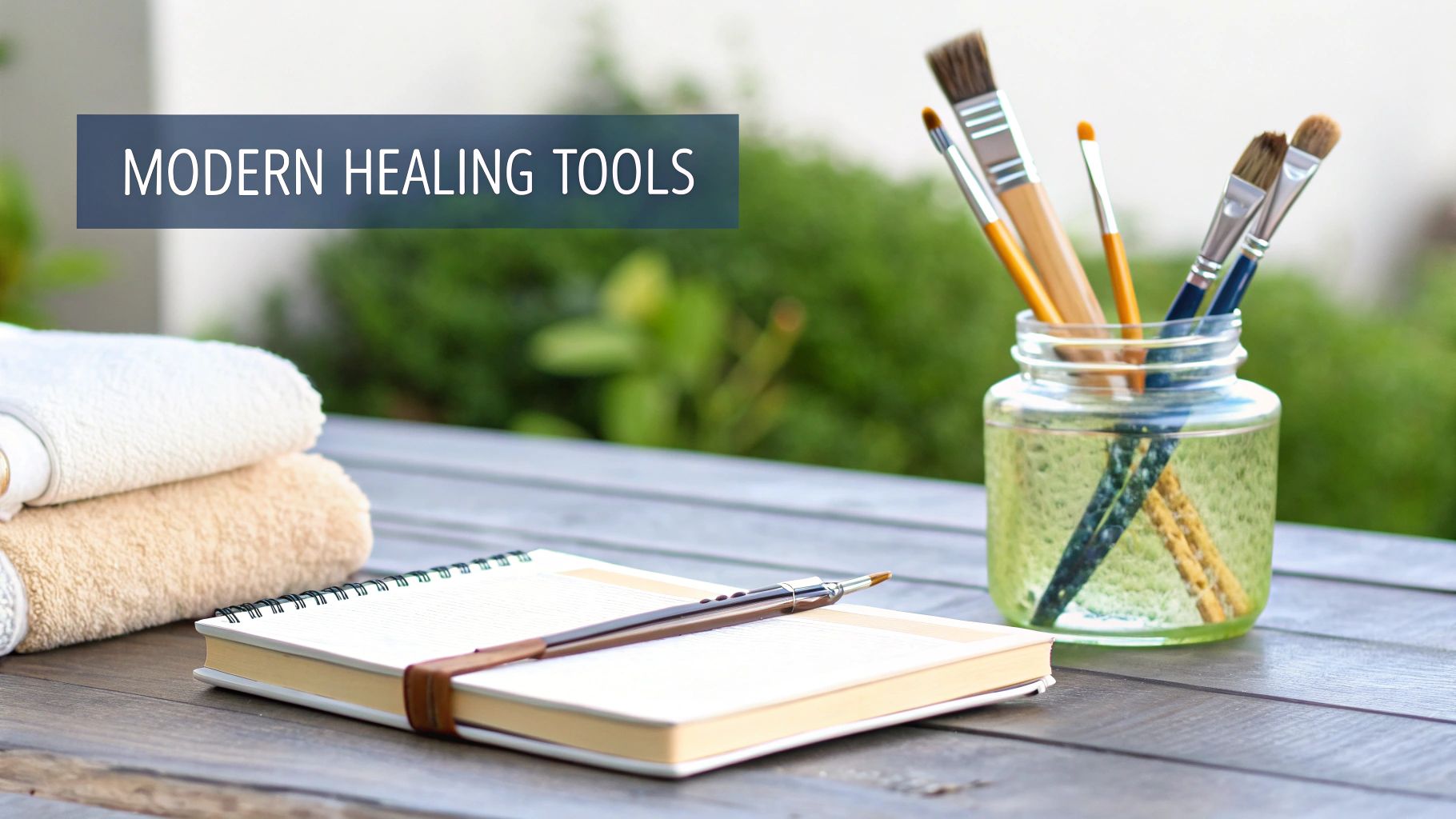
Sometimes, the feelings that come with grief are too big, too deep, or too confusing for words. This is where Expressive Arts Therapy can offer a gentle and creative path toward healing. It uses different art forms as a way to explore and communicate your inner world.
You absolutely do not need to be an “artist” to benefit from this. It’s not about creating a masterpiece; it’s about the process of creation itself.
This could involve:
- Painting or drawing to give colour and shape to an emotion.
- Writing in a journal without worrying about grammar or structure.
- Using clay to physically mould and express a feeling.
- Creating a collage that tells the story of your loss or your love.
These creative outlets can feel less direct and intimidating than talking, allowing you to access and process feelings that might otherwise stay hidden. It’s a way of making the invisible visible, giving you a new perspective on your own healing journey. These modern therapies affirm that there are many paths to healing, and it’s okay to find the one that speaks to you—mind, body, and heart.
When Your Grief Feels Overwhelming
Sometimes, grief doesn’t just visit—it moves in. It can feel like it has taken over every corner of your life, making the simplest daily tasks feel impossible.
If this sounds familiar, please hear this: you are not failing at grieving. This is a very real, valid, and recognized experience.
When the sharp, intense pain of loss stays for a long time without softening, it might be a sign that you need more specialized support. This is sometimes called Prolonged Grief Disorder (PGD), but it’s often more helpful to just think of it as grief that has become “stuck.” The pain stays just as raw and disruptive as it was in the very beginning, long after the loss happened.
This isn’t about a specific timeline or a set of rules. It’s all about how the grief is impacting your ability to live your life.
Recognizing When Grief Is Stuck
It’s one thing to have waves of sadness wash over you, but it’s another thing entirely to feel like you are permanently drowning in them. This kind of overwhelming grief can show up in ways that are deeply personal and often misunderstood by others.
Here are a few relatable examples of what this can feel like:
- An intense, constant yearning: A deep, aching need for the person who died that never seems to fade.
- Feeling that a part of you is gone: A persistent sense that your own identity was lost along with them, making it hard to imagine a future.
- Difficulty engaging with life: An inability to find joy or meaning in activities or relationships that you once cared about.
- Persistent disbelief: Even months or years later, still struggling to accept that the loss is real.
If you recognize these patterns in yourself, it is not a sign of weakness. It is a sign that the weight you are carrying is incredibly heavy, and it’s okay to need help finding a way to carry it. This is a crucial first step toward finding the targeted care you deserve.
Understanding the Need for Specialized Support
In Canada, over one million people experience significant grief each year. While most people find their own way through the grieving process, research shows that about 10-15% of people experience prolonged grief—a severe and persistent condition that gets in the way of daily life.
For this group, specialized grief and loss counselling is often essential for healing. You can learn more about the research on prolonged grief in Canada to better understand this experience.
Seeing your grief in this context helps to remove any sense of stigma or shame. It’s not about doing grief “wrong”; it’s about recognizing that your specific loss and circumstances may require a more focused kind of support.
Acknowledging this need is a powerful act of self-compassion and the first step toward finding a path forward.
If you’re in London, Ontario, and feel ready to take the next step, I am here to walk alongside you with compassion and understanding. At Gentle Pathways we offer a warm, supportive space where you can explore your grief without judgment. You are not alone, and help is here. Feel free to reach out when you’re ready for a free consultation.