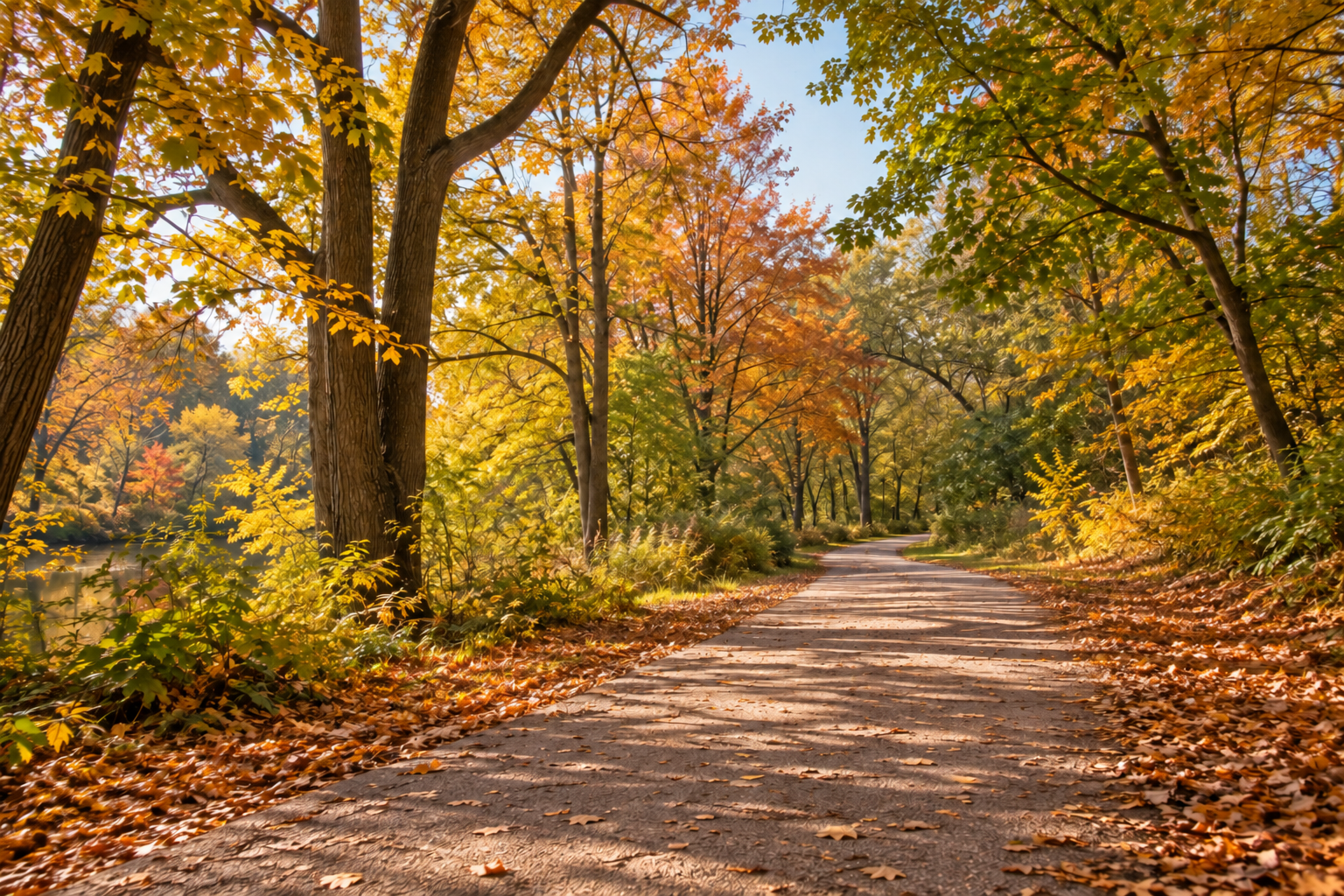
Some fall days seem to invite us outside. The air is warm enough to linger, the light has softened, and the leaves are beginning to change. A walk through a neighbourhood park or along a local trail can offer a small pause in a busy week. You do not need to reach a lookout, count steps, or return feeling transformed for that time to be worthwhile.
When life feels crowded, even a pleasant outing can start to sound like another task. That is why a gentle fall walk works best as an invitation. You can choose a familiar route, move at your own pace, stop at a bench, or simply notice the trees for a few minutes. The point is to make a little room for yourself in an ordinary day.
There is growing research on contact with nature and mental well-being. Some studies suggest benefits for stress, attention, and repetitive negative thinking. Walking itself also has a research base for mood. The findings are encouraging, but they come with limits: a walk will not solve every source of distress, and one particular duration is not a prescription for everyone. This article looks at what the evidence actually says and how to make an autumn outing feel accessible.
Why a warm fall day can feel like an opening
Autumn can be full of transitions. School, work, caregiving, and shifting routines may all ask for attention at once. On a warm day, going outdoors can create a gentle boundary between one part of the day and the next. The simple act of leaving a screen, stepping onto a path, and looking farther than the next room may feel different from trying to rest while still surrounded by reminders of what needs doing.
Fall also offers easy things to notice without trying hard: the sound of leaves underfoot, a tree that has changed since last week, the texture of bark, or light moving across a path. These details can bring your attention back to what is around you. If you have been replaying a conversation or worrying about tomorrow, a small shift in attention may feel welcome. If it does not, you have still spent time somewhere that mattered to you.
There is no need to make the season picturesque. Some days are damp, noisy, or simply ordinary. A local park with traffic in the distance still counts as an outdoor place. Nature does not begin only where the city ends.
What research says about nature, walking, and mental health
Research on this topic brings together several different things: physical movement, exposure to green space, a break from everyday demands, and sometimes time with another person. Those parts can be hard to separate. The most helpful reading of the evidence is that nature contact and walking can be useful supports, with effects that vary by person and setting.
A nature walk may interrupt rumination
Rumination means getting caught in repetitive thoughts about what went wrong or what might be wrong with us. In a 2015 controlled study published in PNAS, healthy adults who took a 90-minute walk in a natural setting reported less rumination afterwards than those assigned to an urban walk. The researchers also observed a change in activity in a brain region associated with self-focused negative thinking.
That is an interesting finding, not a promise that a park walk treats depression or changes everyone’s brain in the same way. The study examined a particular walk and a particular group of participants. Still, it offers a possible explanation for a familiar experience: a different environment can sometimes loosen the grip of a thought loop, even if the underlying problem is still there when you get home.
If you are caught in a difficult thought, you do not need to force it away before you leave. You can let it be present while you notice a turn in the path, the sound of birds, or your feet meeting the ground. Attention may drift back and forth. That is normal.
Time outdoors may support a stress reset
A 2019 field study in Frontiers in Psychology followed adults during self-chosen visits to places that felt natural to them. The researchers measured salivary cortisol, one biological marker related to stress, before and after visits. Cortisol fell more than would be expected from its usual change over the day, and visits of roughly 20 to 30 minutes showed the most efficient change per minute in that study.
It is tempting to turn this into a rule that everyone needs a 20-minute “nature dose.” The study did not establish that. It was relatively small, participants chose their own locations and activities, and cortisol is only one piece of how stress is experienced. A brief visit may be enough to feel useful; a longer one may feel good for different reasons. The practical message is simpler: you can begin with a manageable amount of time rather than waiting until you have a free afternoon.
Walking brings benefits of its own
It helps to remember that the walk itself may matter. A 2024 systematic review and meta-analysis of randomized trials found that walking interventions were associated with reductions in depressive and anxiety symptoms. Results varied across studies and participants, so they should not be read as a guarantee for any one person. They do suggest that an easy, repeatable form of movement can be one way to support mental health.
You do not need to walk briskly to make the experience meaningful. A slow stroll may give you space to notice what is around you. On another day, a slightly faster pace may feel satisfying. The right choice depends on your energy, health, the ground underfoot, and what you want from the outing.
A change of scenery may help attention
Another small 2015 experiment randomly assigned 60 adults to a 50-minute walk in a natural or urban setting. Compared with the urban group, those who walked in nature showed better performance on a working-memory task and reported more favourable changes in mood. That does not mean every walk will make you more productive. It suggests that a green setting may sometimes give attention a different kind of work to do after a demanding day.
What the broader evidence can and cannot tell us
In a large 2019 survey study in Scientific Reports, adults who reported spending at least 120 minutes a week in nature were more likely to report good health and well-being than those reporting no nature visits. The time could be spread over several visits. This was an association, not proof that reaching two hours caused better health, and it should not become another weekly target to feel guilty about.
A more recent 2025 review in BMJ Open looked at nature-based programmes for adults with depression, anxiety, or stress. It found promising changes in some mental health measures, but the authors rated the certainty of the evidence as very low because the studies differed considerably and many had methodological weaknesses. That means we should be cautious about saying how much nature exposure will help a person with a diagnosed condition.
Taken together, these studies give us a reasonable basis to try a park or trail walk if it appeals to us. They do not make it a test of commitment to recovery, and they do not replace counselling, medical care, or changes needed in an unsafe or overwhelming situation.
What counts as connecting with nature?
A trail through a forest is one option, but it is not the only one. A neighbourhood park, a riverside path, a small garden, or a bench beneath a tree can all offer some contact with the outdoors. The setting does not have to be silent. Children playing, dogs passing, and a nearby road may be part of the scene.
For some people, “connecting with nature” means noticing living things: the different shapes of leaves, birds at the edge of a pond, or the way the wind moves through tall grass. For others, it is the chance to move without an immediate destination. You can be thoughtful, distracted, chatty, quiet, or a little tired. There is no required state of mind.
The same flexibility applies to movement. You may walk the full path, use a mobility aid, pause often, or stay near an accessible entrance and enjoy the view. If walking is not comfortable or possible, sitting outdoors can still be a meaningful way to spend time in nature. In the cortisol study above, participants could sit or walk; the study was not a test of athletic ability.
It may help to choose a place that fits the day you are actually having. A short loop close to home can feel kinder than a longer trail that requires planning, parking, and a push to finish. On a day when you want more space, a longer route may be just right. Both choices count.
Finding a park or local trail in London, Ontario
London has options for different kinds of autumn outings. The Thames Valley Parkway runs through parkland along the Thames River. Because it is a multi-use paved route, you can choose a short section instead of committing to its full length. The City of London provides a map and posts construction or detour information, so it is worth checking your intended section before you go.
If you prefer a more wooded trail, the Upper Thames River Conservation Authority lists several routes at Fanshawe Conservation Area, including shorter hiking trails as well as a much longer lake route. Check current access, fees, and trail conditions before making a plan. The longer route has low-water crossings that can be impassable at times; a brief walk on a shorter marked trail is a complete outing in its own right.
You might also choose a park you already know. Familiar entrances, washrooms, benches, and a clear way back can make it easier to relax. If you are exploring one of London’s Environmentally Significant Areas, follow the official access points and marked trails. Staying on the path helps protect the space and makes your own route easier to judge.
Local conditions change with weather and maintenance. A quick look at an official map, a glance at the forecast, and a choice of shoes for the surface are enough planning for many walks. In autumn, leaves can hide roots or slippery patches. It is fine to turn around early or choose a paved path.
A simple way to begin a fall walk
The hardest part is sometimes deciding when and how to start. You can make the plan small: “I will walk to the first bend and see how I feel,” or “I will spend ten minutes at the park after lunch.” Leaving room to choose again once you are outside can lower the pressure to make the outing worthwhile.
Before you leave, check what would help you feel comfortable. That might mean bringing water, dressing in layers, choosing a route with benches, or inviting someone you trust. If you are going alone, tell someone where you plan to be when that would help you feel at ease. If your energy is limited, use a route that brings you back to your starting point without a difficult return trip.
Once you arrive, try letting the first few minutes be ordinary. You do not need to begin with a breathing exercise or a set of instructions. Walk, roll, or sit until you feel a little more settled in the place. If you want a gentle structure, choose one of these invitations:
- Follow a colour. Notice where yellow, orange, or green appears along the path. There is no need to name the trees.
- Listen for layers. Hear a nearby sound, then one farther away. Traffic can be one layer alongside wind or birds.
- Feel the pace that suits you. Notice whether your body wants to slow down, keep a steady rhythm, or rest.
- Pause at a change. A bridge, a clearing, or a bend in the path can be a natural place to stop and look around.
- Take one detail home. Remember a shape, scent, or sound that caught your attention. You do not need a photo to keep it.
These are options, not a checklist. If focusing on your senses feels uncomfortable, skip it. Some people find grounding prompts helpful; others prefer conversation, music played at a safe volume, or simply watching where they are going. The best walk is one you can make your own.
When your mind does not quiet down
People sometimes imagine a nature walk as a guaranteed reset: worry fades, breathing slows, and everything feels clearer. Real days are less tidy. You may still be thinking about a difficult conversation halfway around the loop. You may even notice feelings that were easier to ignore indoors. That does not mean you are doing the walk incorrectly.
You can choose a softer goal than “feel calm.” Perhaps the goal is to give yourself ten minutes away from demands, to move your body gently, or to notice one thing that is not part of the problem. If a thought keeps returning, you might say to yourself, “That is here, and I can keep walking for now.” You do not have to argue with it or turn the walk into a test of mindfulness.
Sometimes being outside can feel exposed or overstimulating. Crowded paths, off-leash dogs, uneven ground, or reminders of a difficult experience may change what feels safe. Choose a different place, go with a trusted person, stay near an exit, or head home. Responding to what you need is part of caring for yourself.
If you are living with persistent anxiety, low mood, trauma symptoms, or severe stress, a walk can sit alongside professional support. It does not have to carry the whole weight of helping you feel better. If your symptoms are making daily life hard, reaching out for care is a sensible next step.
Alone, together, or somewhere in between
A solo walk may offer quiet and space to think. A shared walk can make it easier to leave home or provide low-pressure company. Neither is inherently more restorative. Consider what you need that day and whom you feel comfortable inviting.
Walking side by side can make conversation feel different from sitting face to face. You might ask a friend to join you without expecting a deep talk: “Would you like to walk through the park for a bit?” You can chat about the leaves, talk about something difficult, or enjoy stretches of silence. If you are supporting someone who has had a hard week, let them choose whether they want conversation or just company.
Children may want to stop often, collect observations, or take a route that makes little sense on a map. That can be part of the outing rather than a delay. A walk with family does not need to cover much ground to offer a change of scene.
Making room for real-life barriers
Advice to “just get outside” can miss the realities of work schedules, pain, mobility needs, transportation, caregiving, and access to safe green space. These are not failures of motivation. A helpful plan takes them seriously.
If time is tight, look for a short route linked to something you already do: a few minutes before returning home, a loop during a lunch break, or a stop at a park on the way to an errand. If reaching a trail requires too much effort, a nearby tree-lined street may be the better choice. You can also decide that this is not the week for another activity.
If a path is difficult to navigate, check its surface and facilities before you go. The paved sections of the Thames Valley Parkway may suit some people better than a woodland trail, although construction and weather can still affect access. An accessible bench, a shorter route, or going with someone can make a difference. The aim is to find a setting that welcomes your actual body and circumstances.
If outdoor space has not always felt safe, choose a place and time that help you feel more secure. You may prefer a busy park, daylight, a familiar loop, or company. You do not need to push yourself onto an isolated trail to receive permission to enjoy nature.
And if the day is unexpectedly cold, rainy, or simply too much, it is all right to change plans. A warm fall day is an opportunity, not an obligation.
Can small walks become a gentle routine?
Some people enjoy making a loose ritual of visiting the same place as the season changes. Familiarity can remove the need to decide where to go, and it lets you notice what is different: a tree turning colour, fewer leaves on a branch, a new sound along the river. Other people prefer variety. The best routine is the one that fits your life without becoming another measure of success or failure.
Rather than aiming immediately for a number of minutes each week, you might ask, “When would a little outdoor time feel most welcome?” Perhaps after a difficult meeting, before picking up a child, or on a weekend morning when you have no destination. You can start with one visit and see whether you want another.
Notice what the walk gives you, if anything. Maybe you feel lighter, maybe you sleep no differently, or maybe the main benefit is that you shared time with a friend. The research describes patterns across groups; your experience tells you what works for you. A useful habit can be modest and imperfect.
Common questions about fall nature walks
Do I need a forest for the benefits to count?
No. Studies use many kinds of natural settings, including urban green spaces. A local park or river path can be a practical starting point. Different environments may feel different to different people, so choose a place that is accessible and pleasant enough for you to return to.
How long should I stay outside?
There is no proven minimum that applies to everyone. The cortisol study above found a useful signal around 20 to 30 minutes, while other studies looked at longer walks or weekly totals. Those numbers describe the studies, not a requirement for your day. Five comfortable minutes are a reasonable start if that is what you have.
What if I would rather sit than walk?
Sitting outdoors can still offer a change of setting and a chance to notice nature. It may also be the most accessible choice for you. Walking adds movement, which has its own evidence base, but you do not need to move continuously to make outdoor time worthwhile.
Should I leave my phone at home?
Only if that feels useful and safe. Your phone may help with maps, accessibility, family needs, or peace of mind. You can silence notifications for part of the outing if you want fewer interruptions. There is no rule that a “real” nature experience requires being unreachable.
What if I feel worse after the walk?
That can happen. Sometimes a quieter setting leaves more room to notice distress, or the route itself may have felt uncomfortable. Think about whether a shorter, more familiar, or more social outing would fit better. If difficult feelings persist or intensify, consider talking with a trusted person or a mental health professional. A walk is one possible support, not a treatment you have to keep repeating when it does not help.
A small invitation for the next warm day
When the next mild fall afternoon arrives, you might choose a park, a short stretch of a local trail, or the nearest place where you can see a few trees. Let the outing be as simple as stepping outside, finding a comfortable pace, and allowing your attention to land where it will. You are allowed to enjoy the season without turning it into work.
If stress, anxiety, or low mood have been taking up more space than a walk can address, Gentle Pathways offers counselling in London, Ontario, and virtual care across Ontario. Support can help you make sense of what you are carrying while you continue to find small, workable ways to care for yourself.
Research and local trail information
- Bratman and colleagues (2015): nature experience and rumination
- Bratman and colleagues (2015): nature walks, mood, and working memory
- Hunter and colleagues (2019): urban nature visits and stress biomarkers
- 2024 systematic review: walking and symptoms of depression and anxiety
- White and colleagues (2019): weekly nature contact and well-being
- Jessen and colleagues (2025): review of nature-based mental health interventions
- City of London: Thames Valley Parkway and Upper Thames River Conservation Authority: trails